A vertical-pivot wing turbine (PAVA) for wind or water
A rotating turbine assembly with multiple wing assemblies that pivot about shafts parallel to the central drive shaft to present a broad face to incident flow in the drive quadrant and align with flow in the glide quadrant. Wings are mounted between two end assemblies and may include articulating flaps; a central airfoil deflects flow toward wings in the drive quadrant. Intended users include small wind or water-power equipment makers and installers who deploy turbines for distributed generation or fluid-energy harvesting.
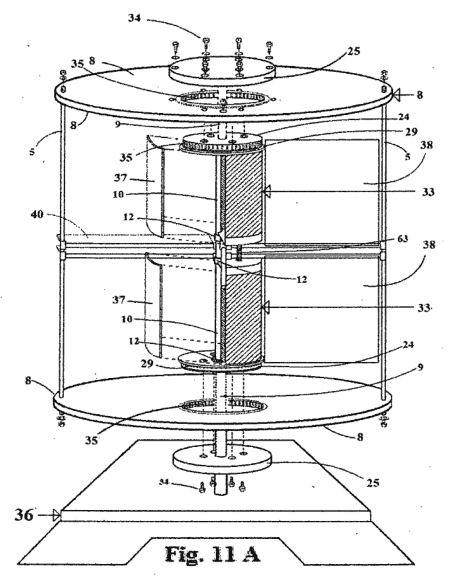
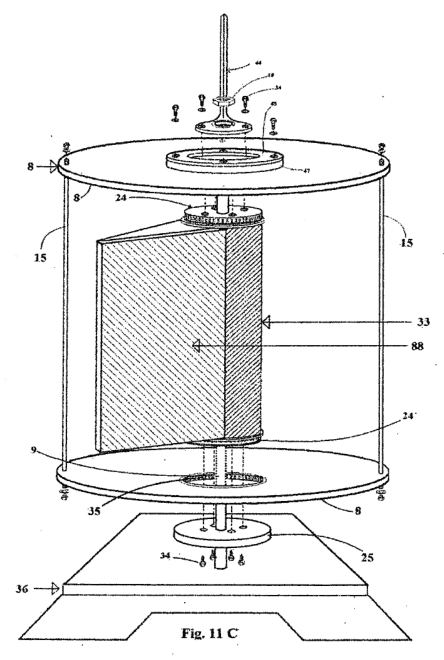
(57) What the patent covered
This write-up was generated by AI from the patent's text and may contain mistakes, so check it against the original patent before relying on it.
The independent claim covers a turbine with a rotatable central drive shaft and two spaced end assemblies that secure multiple primary wing assemblies. Each wing is mounted on a pivot axis parallel to the central axis and can pivot between a radial "drive" position (transverse to incident flow) and a tangential "glide" position (parallel to incident flow); the pivot permits limited angular motion, and a central airfoil is provided to deflect fluid toward the wings' drive positions. Claim 12 adds secondary wing assemblies with analogous pivoting about parallel axes.
Distinguishing feature: Wings pivot about vertical (parallel-to-shaft) axes so they present large frontal area in the drive quadrant and align with flow in the glide quadrant, plus an onboard central airfoil and optional secondary wing stages.
Novelty 3/5. Pivoting blade sections and variable-pitch blades were known for turbines; this patent emphasized vertical pivot axes and staged concentric wing rings to increase frontal capture and reduce drag, which is a modification of familiar variable-area designs.
Manufacturing
Likely assembled from stamped or machined metal end discs/hubs, turned or extruded central drive shaft, injection-molded or laid-up composite wing panels, fitted stainless-steel pivot shafts and riveted/bolted assembly; optional flaps hinged to wing panels and hand assembly of stages.
Materials: Sheet metal (aluminum or steel) for end assemblies and struts, composite or metal wing panels (fiberglass, aluminum), hinges/pivot shafts (stainless steel), rubber or polymer seals/bushings for pivots.
Manufacturability 4/5. Manufacture requires several simple metal or composite parts, standard pivots and bolting; tooling for discs, shafts and wings plus moderate assembly labor are needed but no microelectronics or tight optical tolerances.
Market demand
Comparable products are on sale; this exact design was not found. No current US listings for the exact PAVA wing-assembly turbine; only patents describe the design (e.g., parallel-and-vertical-axis configurations) and there are several commercial vertical-axis wind turbine options, but not this specific PAVA-wing assembly product.
Demand check by web search, week of Oct 12, 2026. Listings change frequently.
Buyers: Small-scale wind or hydro project developers, off-grid homeowners, equipment makers for distributed renewables.
Sourcing
Factories list related products that could be adapted, at about $20670.96 per unit with a typical minimum order of 1 unit. OEM/private label and customization options appear available; the listing is for a vertical-axis wind turbine generator (5–20 kW range) with vertical axis and multi-blade design, which is the closest match to a PAVA-style turbine in these marketplaces.
- Tianjin Galaxy Tech Co., Ltd. · MadeInChina.com · MOQ 1 set$20670.96
Supplier prices are from public listings found by web search, quoted before customization, shipping and duties. Use them to decide whether to request a quotation.
Before manufacturing
No related continuation or divisional patents in force were found. Design patents, trademarks and unrelated patents may still cover the product.
Patent has lapsed; practical issues include structural loads on pivots, fatigue of articulating flaps, certification (IEC wind turbine standards) and a crowded market for small turbines.
About 1.5% of lapsed patents are later revived by their owners. This page is a research lead, not legal advice. Obtain a freedom-to-operate opinion before manufacturing.