Collective force-field matching of grayvalue distributions
A method to match two grayvalued data sets (pixels, voxels, or other scalar-valued elements) by mapping elements from a source set to elements in a target set, computing local grayvalue distribution differences, converting those differences into per-element force vectors, and combining the vectors into a single force and torque to iteratively move the source elements collectively until the global distributions align. Typical users are medical-image and volume-registration engineers who need rigid or quasi-rigid alignment of dense scalar fields.
(57) What the patent covered
This write-up was generated by AI from the patent's text and may contain mistakes, so check it against the original patent before relying on it.
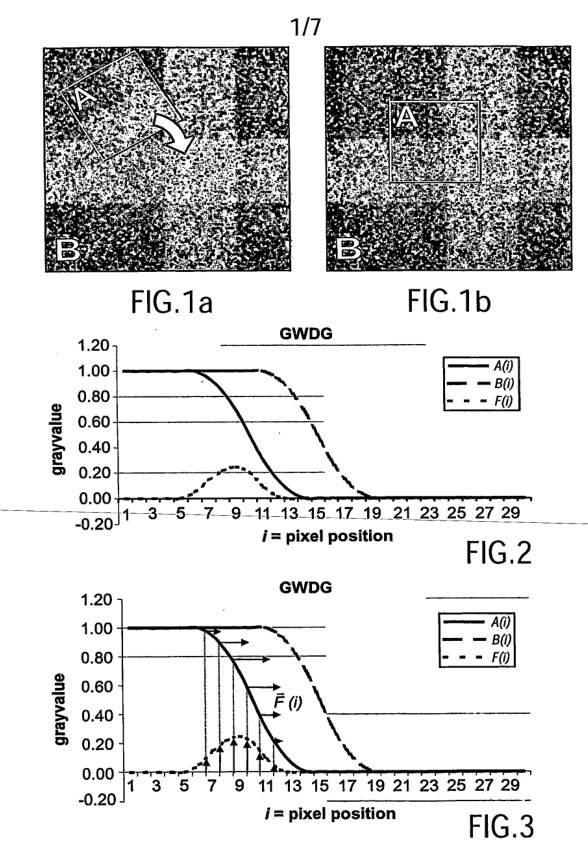
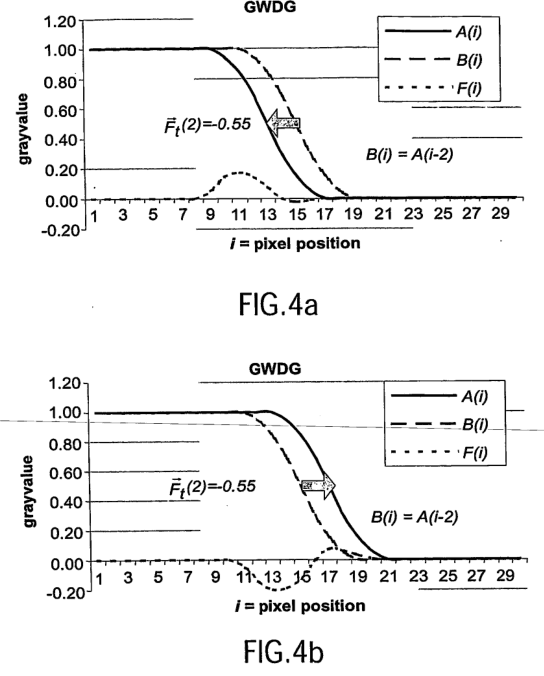
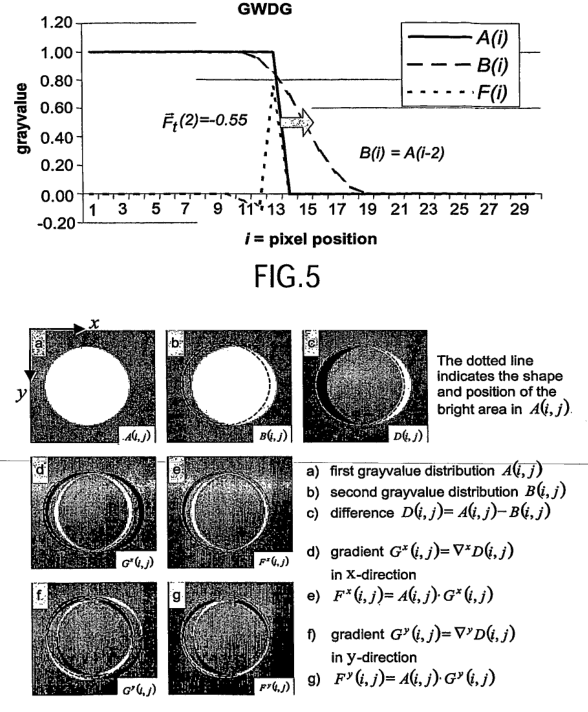
The independent claim required: (1) mapping first elements to second elements and computing a local grayvalue distribution difference per mapped element; (2) deriving for each first element a force vector from that local difference indicating preferred motion size and direction; and (3) combining those separate force vectors into one overall force and one overall torque acting on the first elements collectively to iteratively update the mapping.
Distinguishing feature: Converting per-element local grayvalue distribution differences into a force field and reducing that field to a single collective force and single collective torque to drive iterative collective motion of the source elements.
Novelty 3/5. At filing time many registration methods used similarity metrics, correlation or active contours; this patent framed local intensity mismatches as forces and explicitly aggregated them into a single rigid-body-like force and torque, which is a clear improvement on familiar elementwise iterative schemes but not a wholly new domain.
Implementation
A small team would implement this by computing local difference maps between source and target (per pixel/voxel neighborhoods), converting neighborhood differences into vectors (e.g., gradient-weighted displacements), summing vectors to obtain a net force and torque, and applying the resulting rigid-body update (translation + rotation) to the source field, then iterating until convergence. Use numpy / PyTorch for array ops, SimpleITK or nibabel for medical volumes, and a small loop that updates transforms and recomputes local differences.
Components: Source grayvalue field (image/volume), target grayvalue field (image/volume), local neighborhood statistics calculator, force-vector computation routine, optimizer that applies collective force and torque (rigid transform).
Buildability 5/5. Main effort is implementing stable local-difference-to-vector mapping and numerical care in combining vectors into a torque (rotation) for convergence; no special hardware is required.
Market demand
Comparable products exist; none doing exactly this was found. Multiple open-source software packages for intensity-based registration exist (elastix, drop2, INSPIRE), with ongoing research activity and academic adoption; several provide ITK-based pipelines and 2D/3D registration capabilities.
- elastix · elastix project (opensource toolbox, ITK-based)free
- drop2 (dropreg) · biomedia-mira / drop2 GitHub repositoryfree
- INSPIRE: Intensity and Spatial Information-Based Deformable Image... · MIDA group (open-source implementation on GitHub)free
Demand check by web search, week of Oct 12, 2026. Listings change frequently.
Buyers: Medical imaging teams; image registration tool vendors.
Before manufacturing
No related continuation or divisional patents in force were found. Design patents, trademarks and unrelated patents may still cover the product.
Patent has lapsed; practical issues include sensitivity to initialization, local minima, noise, and existing robust intensity-based registration libraries (mutual information, correlation) that may already meet needs.
This patent has reached the end of its full term and cannot be revived. This page is a research lead, not legal advice. Obtain a freedom-to-operate opinion before manufacturing.