Compute hedge notional that nulls PCA curve exposures and minimizes key-rate exposures
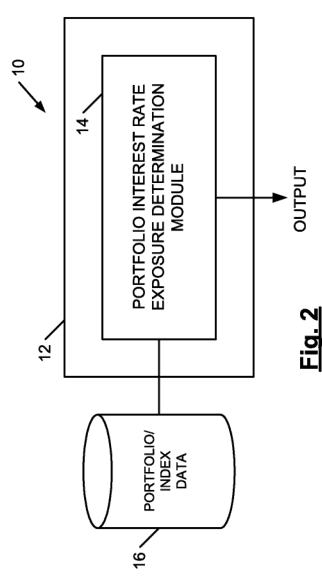
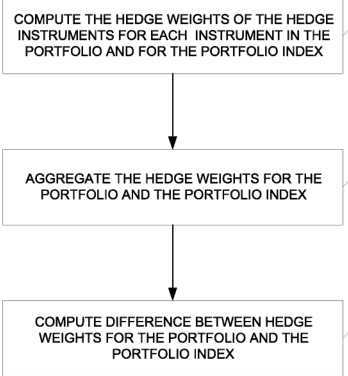
Method to analyze and hedge interest-rate exposure of a bond or portfolio by (1) identifying N significant yield-curve constituent exposures (for example from PCA or factor analysis) and (2) computing a unique vector of hedge notionals for M hedge instruments (M>N) using a closed-form matrix formula that enforces nulls on the N constituents and minimizes key-rate exposures. Portfolio-level exposure is produced by aggregating instrument-level hedge weights and comparing the aggregated portfolio hedge to an index hedge. Users are fixed-income portfolio managers and risk desks producing hedges and relative exposure metrics.
(57) What the patent covered
This write-up was generated by AI from the patent's text and may contain mistakes, so check it against the original patent before relying on it.
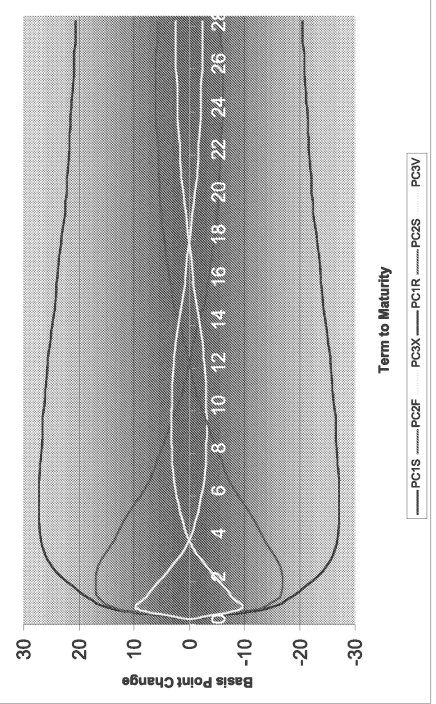
The main independent claim covers a computer-implemented method that (a) identifies N significant yield-curve constituent exposures and (b) computes a unique set of hedge weights x (numbers of units of notional for M hedge instruments, M>N) using the explicit matrix formula x = B^{-1}[M^{T}(MM^{T})^{-1}p + z] with M = AB^{-1} and p = y − Mz, where A is the matrix of constituent exposures for hedge instruments, B is the matrix of key-rate exposures for hedge instruments, y and z are the matrices of the instrument's constituent and key-rate exposures respectively, and all matrix elements are in the currency of the hedge instruments.
Distinguishing feature: Providing a closed-form matrix solution that combines PCA/factor-derived constituent exposures with key-rate exposures to produce a unique hedge-notional vector for M>N hedge instruments.
Novelty 3/5. PCA/factor hedging and key-rate duration were already common; the patent combined them and gave an explicit algebraic solution for an overcomplete hedge set (M>N).
Implementation
A small team would ingest bond prices and a cross-section of yields, compute PCA or factor loadings to identify N constituents, compute key-rate sensitivities for candidate hedge instruments, assemble matrices A, B, y and z, and evaluate x = B^{-1}[M^{T}(MM^{T})^{-1}p + z] with M=AB^{-1} to obtain hedge notionals; aggregate instrument-level x across a portfolio and compare to an index hedge to report relative exposure. Use Python with NumPy/SciPy, a pricing library for key-rate durations, and a streaming market-data API.
Components: Database of bond cash flows and market prices, PCA or factor-analysis component extractor (numerical linear algebra library), matrix algebra engine (BLAS/LAPACK, NumPy), market data feed of hedge-instrument key-rate sensitivities (futures, swaps, FRAs).
Buildability 5/5. Main effort is data quality for key-rate sensitivities and stable numerical linear algebra when MM^{T} is ill-conditioned; implementation requires standard libraries and market feeds.
Market demand
No demand check has been run for this patent. Likely search terms: PCA bond hedge weights, key-rate duration hedging, matrix hedge solution fixed-income exposure. The links in the sidebar open these searches.
Buyers: Fixed-income portfolio managers and risk desks.
Before manufacturing
No related continuation or divisional patents in force were found. Design patents, trademarks and unrelated patents may still cover the product.
Numerical instability if MM^{T} is near singular, and results depend on the chosen key rates and PCA/factor specification; patent lapsed but related literature and conventions remain relevant.
This patent has reached the end of its full term and cannot be revived. This page is a research lead, not legal advice. Obtain a freedom-to-operate opinion before manufacturing.