Declarative API test definitions with in-memory pipelined data
Defines API tests and test suites as declarative metadata structures that list the entity under test, inputs, and expected outputs. Allows outputs from one test to be stored in an in-memory data structure and consumed as inputs by subsequent tests to form pipelined test flows. Used by developers and QA teams testing API frameworks and implementations.
(57) What the patent covered
This write-up was generated by AI from the patent's text and may contain mistakes, so check it against the original patent before relying on it.
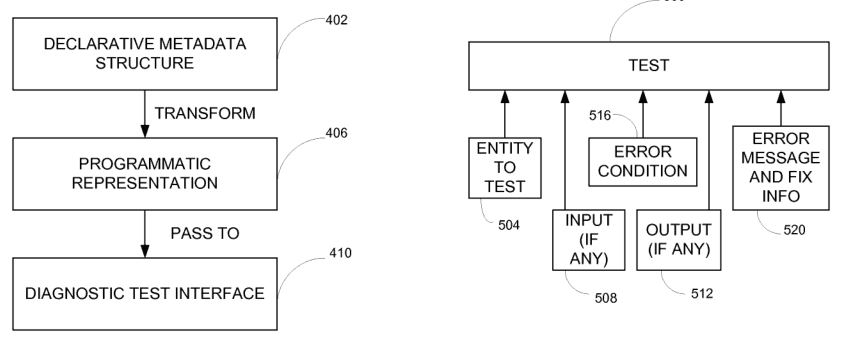
The main independent claim covered a declarative metadata structure stored on a computer-readable medium that specifies an entity to be tested, a first metadata block containing inputs, a second metadata block containing expected outputs, and a specification of a pipelined datum that is accessible by this API test and by a second API test, where the pipelined datum is read from or written into an in-memory data structure. A related independent claim covered a declarative test-suite structure of multiple entities (methods) where at least one output from a first method is stored in memory and used as an input to a second method.
Distinguishing feature: Encoding API tests and inter-test pipelined data flow as declarative metadata rather than as hard-coded test procedures.
Novelty 3/5. Declarative test specifications and data-driven tests existed, but the explicit metadata-first structure that named pipelined in-memory data passed between API test entries was a specific improvement.
Implementation
A small team would implement a metadata schema (JSON or YAML) that lists test cases: target API method, input parameters, expected outputs, and named pipelined data keys. A lightweight test runner reads the metadata, invokes the API (directly in-process or via a client), stores outputs into an in-memory map under the named keys, and substitutes those keys into subsequent test inputs before running assertions.
Components: Declarative metadata files (XML, JSON, YAML), Test runner that reads metadata and invokes API methods, In-memory data store (process memory, Redis, or embedded key-value map), Assertion/expected-output checker.
Buildability 5/5. Main work is engineering the metadata schema and test runner; harder parts are mapping complex API types and managing lifecycle/state for in-memory pipelining across tests.
Market demand
No demand check has been run for this patent. Likely search terms: declarative API test framework, data-driven API testing pipelined data, test metadata driven API tests. The links in the sidebar open these searches.
Buyers: Software teams and QA engineers for server-side APIs.
Before manufacturing
No related continuation or divisional patents in force were found. Design patents, trademarks and unrelated patents may still cover the product.
Patent has lapsed; similar data-driven and declarative test frameworks are common, so integration and type-mapping work and test isolation are the practical challenges.
This patent has reached the end of its full term and cannot be revived. This page is a research lead, not legal advice. Obtain a freedom-to-operate opinion before manufacturing.