Coalesced transfer of method calls to Java event dispatch thread
Mechanism to send method calls created on any thread to the Java Event Dispatch Thread (EDT) with per-call coalescing rules so queued calls can be merged before execution. Call creators specify method, target object, arguments and a coalescing indicator; the queue applies coalescing and the EDT executes the coalesced call. GUI frameworks, background-worker libraries and Swing-based applications are the intended users.
(57) What the patent covered
This write-up was generated by AI from the patent's text and may contain mistakes, so check it against the original patent before relying on it.
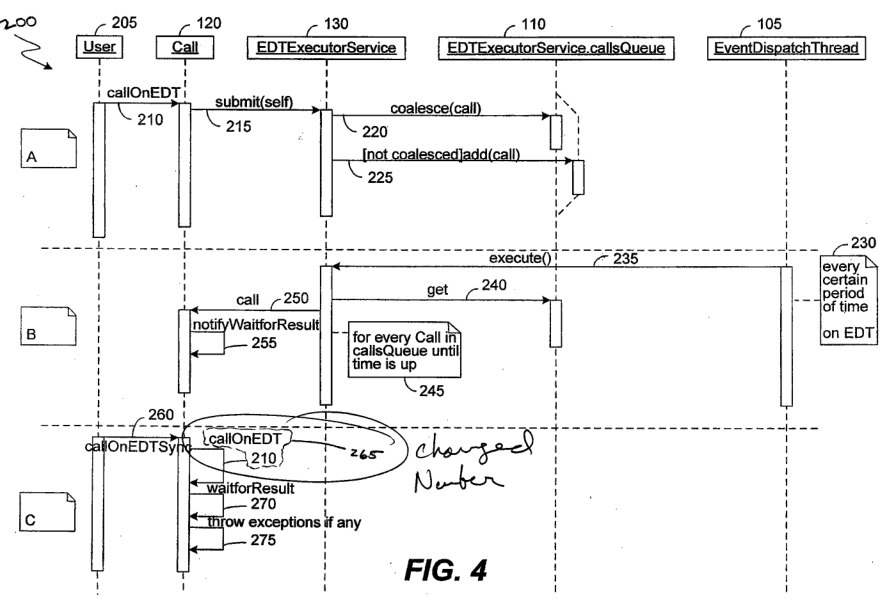
The patent claimed creating a call on an invoke thread that includes (i) a method identifier, (ii) an object identifier, (iii) one or more arguments, and (iv) a coalescing indicator; sending that call into the EDT queue where one or more prior calls are stored; coalescing the new call with a previous queued call according to the indicated coalescing type; retrieving the coalesced call and executing the identified method with the arguments on the EDT.
Distinguishing feature: Inclusion of an explicit coalescing indicator in the cross-thread call object and performing queue-side coalescing before EDT execution.
Novelty 3/5. At filing time Swing/EDT queuing and invokeLater/invokeAndWait were common; adding a per-call coalescing indicator and queue-level coalescing was a focused improvement rather than a new class of system.
Implementation
Implement a lightweight Call object (method reference or Runnable, target object reference, argument payload, enum coalescing flag). Use a concurrent queue plus a short map keyed by (target, method, coalescing type) to detect an existing queued call; when enqueuing, atomically check the map and merge or replace according to the flag. On the EDT run a dispatcher (SwingUtilities.invokeLater or a single-threaded Executor) that drains the queue and invokes the resolved calls on the EDT. Provide APIs for callers to create calls and specify coalescing semantics.
Components: Producer thread context (background/worker thread), call envelope object with fields: method id, object id, arguments, coalescing indicator, EDT-side queue with lookup/coalescing logic, EDT executor that dequeues and invokes target methods.
Buildability 5/5. Main work is correct concurrent queuing and merge rules and ensuring calls execute only on the EDT; no special hardware or large data is required.
Market demand
No demand check has been run for this patent. Likely search terms: EDT coalescing Swing invokeLater, cross-thread UI call coalescing, queue coalescing for GUI event dispatch. The links in the sidebar open these searches.
Buyers: Desktop Java/Swing application developers; UI framework maintainers.
Before manufacturing
No related continuation or divisional patents in force were found. Design patents, trademarks and unrelated patents may still cover the product.
Similar patterns and APIs (SwingUtilities.invokeLater, SwingWorker, event coalescing in toolkits) are common; other patents or library implementations may be relevant.
This patent's full term ends on Oct 25, 2026. A patent that has run its full term cannot be revived. This page is a research lead, not legal advice. Obtain a freedom-to-operate opinion before manufacturing.