Touchless water-dispense panel with three capacitive object detectors
A water dispenser control system that enables touchless dispensing by sensing user hand gestures through multiple capacitive object detection units mounted under the front cover of a dispensing panel. A controller compares gesture patterns detected by a touchless locking module and a touchless dispensing module and opens one of at least two valves (for hot, cold, purified water) when the detected gestures meet preset conditions; intended for shared water dispensers in public or institutional settings.
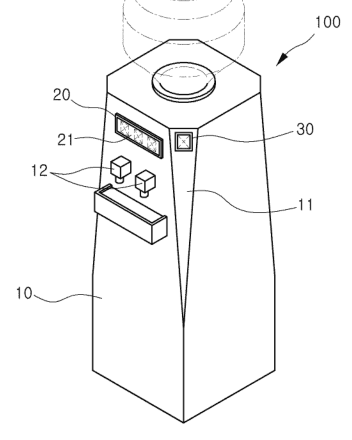
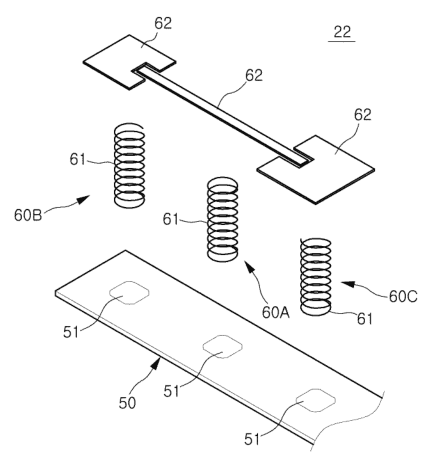
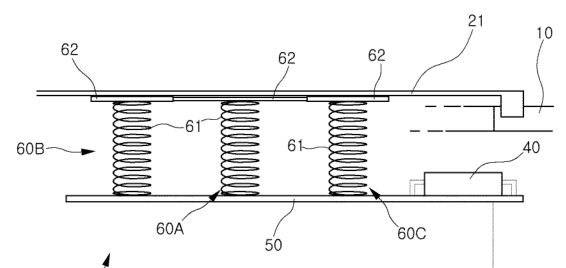
(57) What the patent covered
This write-up was generated by AI from the patent's text and may contain mistakes, so check it against the original patent before relying on it.
The main independent claim covers a touchless dispensing module comprising a circuit board with a touch sensor chip and three object detection units (one center, one left, one right) connected to capacitive input terminals and erected toward the panel cover, where the center unit has a shorter object recognition distance from the cover than the left and right units, and each unit has a support and a receiving pad shaped to conform to the inner surface of the cover.
Distinguishing feature: Using three capacitive object detectors with differing detection distances and shaped receiving pads mounted under the panel cover to read gesture patterns for locking and dispensing control.
Novelty 3/5. Capacitive proximity sensing for touchless controls was known; the novelty is the specific arrangement of three sensors with different sensing distances and matching receiving pads to distinguish gestures and enforce locking/dispensing conditions.
Manufacturing
PCB assembly with surface-mount touch sensor IC, injection-molded plastic support pieces with shaped receiving pads bonded or fastened to the PCB, final assembly inserted behind a plastic panel cover and wired to the dispenser controller; likely hand or machine assembly for cabling and enclosure fit.
Materials: FR‑4 circuit board, PCB-mounted capacitive touch sensor IC, molded plastic supports (ABS or PC), conductive receiving pads or traces (copper/ITO).
Manufacturability 4/5. Multiple simple parts (PCB, three molded supports/pads, cover, controller) and electrical assembly are required; does not require high-precision optics but needs reliable PCB-to-pad electrical coupling and enclosure sealing.
Market demand
Comparable products are on sale; this exact design was not found. Several established brands offer hands-free, touchless hydration solutions for public/commercial spaces (including bottle-fill stations and wall-mounted dispensers) with sensor activation; listings show multiple vendors and configurations but exact pricing varies by model and retailer.
- Zurn Elkay ezH2O LBWD00WHC Built-In Filtered Bottle Filling... · WebstaurantStore
- Filtrine B103-RB-HF Hands Free Water Bottle Filling Station · Filtrine
- HYDR8 4i Countertop Touchless Water Dispenser... · HYDR8 Shop
Demand check by web search, week of Oct 12, 2026. Listings change frequently.
Buyers: Managers of shared facilities (hospitals, offices, schools) or water cooler manufacturers.
Sourcing
Factories list related products that could be adapted, at about $6.10–$6.35 per unit with a typical minimum order of 60 units. Similar touchless dispensing technology (automatic liquid dispenser) that can be OEM/ODM customized; explicit water-dispensing panel variants may require adaptation of the sensor board and enclosure.
- Hong Kong GhostClick Group Limited · Alibaba.com / Alibaba.co.uk · MOQ 60-499 pieces$6.35
Supplier prices are from public listings found by web search, quoted before customization, shipping and duties. Use them to decide whether to request a quotation.
Before manufacturing
No related continuation or divisional patents in force were found. Design patents, trademarks and unrelated patents may still cover the product.
Practical risks include sensitivity tuning and false triggers through varying cover thickness/materials, and crowded market for touchless dispensers; patent has lapsed so no active claim enforcement but one should verify other active patents before product development.
About 1.5% of lapsed patents are later revived by their owners. This page is a research lead, not legal advice. Obtain a freedom-to-operate opinion before manufacturing.