Meta-network that aggregates and propagates relationships across multiple social/business networks
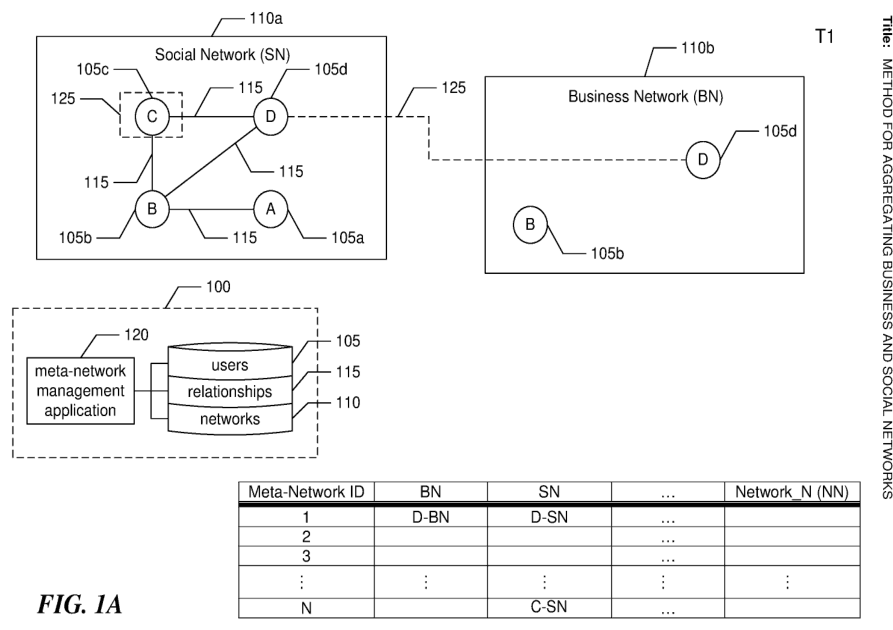
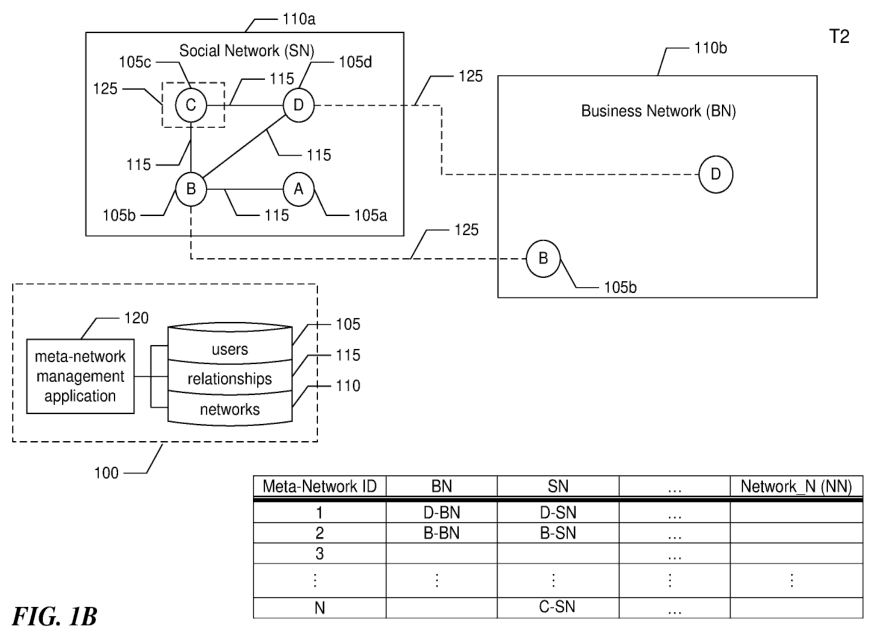
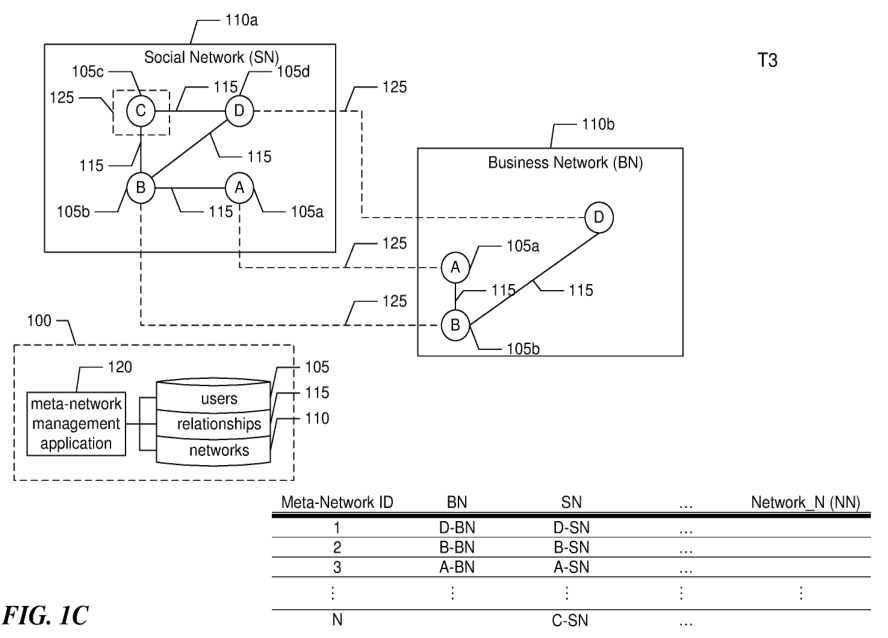
A system that registers users and their network affiliations in a central meta-network, detects when a user has a relationship with someone in one registered network but not in another, displays those candidates with similarity metrics, and sends invitations to establish relationships in the other networks. The meta-network stores user IDs, network IDs and relationship links; users search or browse matches and invite selected people into additional networks. Target users are people and organizations that maintain accounts across multiple social, business or interest networks.
(57) What the patent covered
This write-up was generated by AI from the patent's text and may contain mistakes, so check it against the original patent before relying on it.
The main independent claim covers a computer system that (1) registers a user and their network identifiers with a meta-network, (2) identifies other users who are connected to the user in one registered network but not connected in at least one other registered network, (3) displays those identified users, (4) accepts user selection, and (5) sends invitations to the selected users to establish relationships in the other network(s).
Distinguishing feature: Centralizing cross-network affiliation records and using them to identify and invite contacts to establish missing relationships across multiple, heterogeneous networks.
Novelty 3/5. At filing time automated contact import and address-book syncing existed, but using a meta-network to map per-network relationships and propagate invitations across multiple distinct social/business networks was a specific improvement.
Implementation
A small team would run a cloud-hosted relational or graph database to store users, network affiliations and edges; build an identity-linking service that ingests OAuth or user-provided account identifiers; implement a search API that finds contacts connected in one network but not another and computes similarity scores; provide a web UI that renders lists or force-directed mini-maps for selection; and integrate network-specific invitation delivery via each network's API or email as a fallback.
Components: Central meta-network database (user IDs, network IDs, relationship links), identity/linking layer (map account identifiers across networks), search and similarity engine (attribute filters and similarity scoring), UI mapping/visualization component (lists or graph view) and invitation API clients.
Buildability 5/5. Hard parts are reliable identity linking across networks and obtaining/writing invitations via each network's API or accepted channels; the rest is standard web/backend engineering.
Market demand
No demand check has been run for this patent. Likely search terms: cross-network contact aggregator, social network relationship propagation, meta-network contact invites. The links in the sidebar open these searches.
Buyers: People and organizations managing multiple social/business accounts.
Before manufacturing
This patent has 1 related US patent (continuation, divisional or parent) that may remain in force: US 9,342,833. Review their claims before proceeding.
Practical risks include accurate identity resolution across networks, API rate limits or policy restrictions of third-party networks, and privacy/compliance requirements for sharing contact relationships.
About 1.5% of lapsed patents are later revived by their owners. This page is a research lead, not legal advice. Obtain a freedom-to-operate opinion before manufacturing.