App catalog gate that restricts apps to declared network/device services
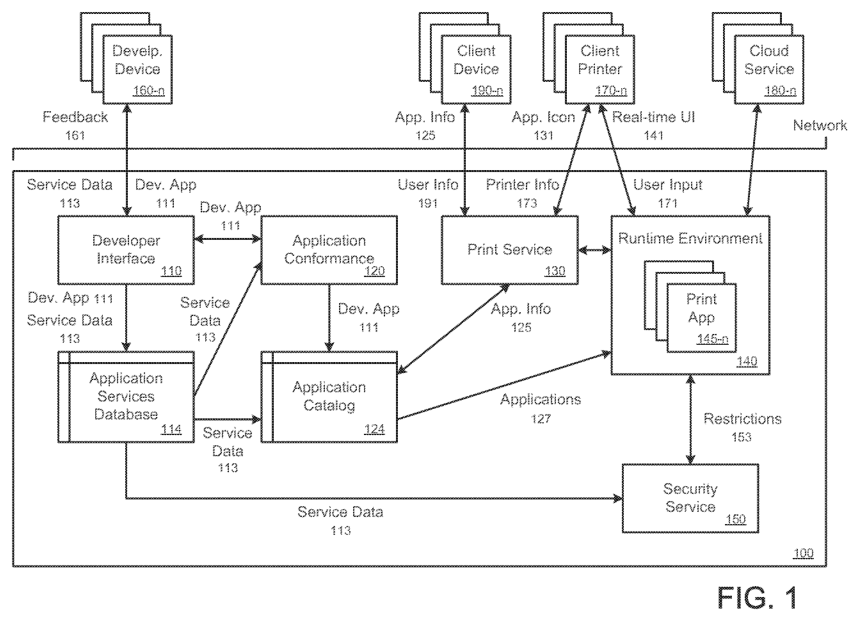
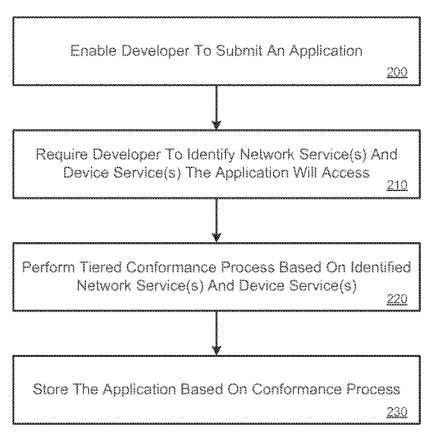
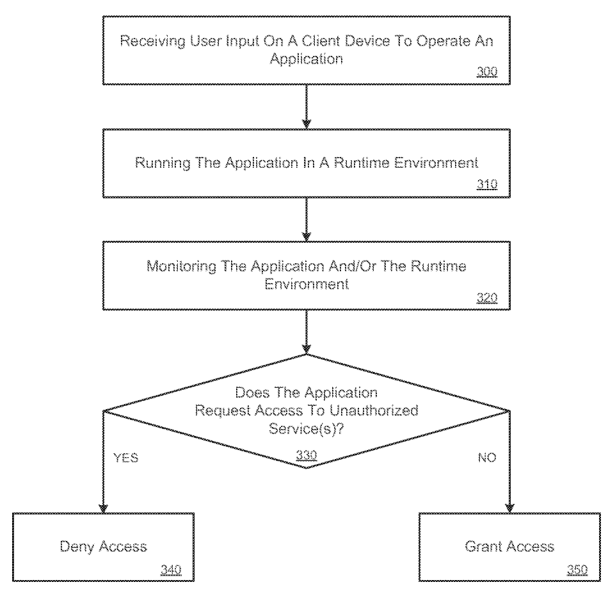
A portal-driven system that accepts developer-submitted applications, requires developers to declare which network and device services the app will use, reviews the submission with either a strict or relaxed conformance process based on the declared number of services, and enforces at runtime that the app cannot access services outside the approved set. Target users are platform operators that host an application catalog for networked devices (example: web-enabled printers) and developers who publish apps to that catalog.
(57) What the patent covered
This write-up was generated by AI from the patent's text and may contain mistakes, so check it against the original patent before relying on it.
The main independent claim requires: a developer portal that collects a submitted application and a developer-declared list of specific network services the application will access; logic that counts the declared services and compares that count to a threshold to choose either a strict or relaxed conformance review; and performing the chosen conformance review prior to approving/uploading the app to an application catalog for use in the network.
Distinguishing feature: Using the developer-declared count of services to select between a strict or relaxed conformance review workflow, and then enforcing a predetermined allowed-service set at runtime.
Novelty 3/5. At filing time, app catalogs, developer portals and runtime permission enforcement were common; the novelty is the explicit service-count threshold driving different review paths rather than a single review pipeline.
Implementation
Build a web portal that requires developers to submit app bundles plus a declarative manifest listing network and device services; implement a microservice that counts services and routes the submission to either a fast-track or full-review workflow in the CI/CD pipeline; store approved manifests in the catalog; enforce allowed-service sets at runtime with a proxy or sandboxing layer that intercepts outbound service calls and blocks calls not in the approved manifest.
Components: Developer portal (web front end), application catalog / metadata store, conformance review engine (rules/workflow), runtime enforcement gatekeeper (proxy or sandbox).
Buildability 5/5. Most work is software: manifest schema, review workflows and a runtime enforcement proxy; the hard parts are defining consistent service identifiers and integrating enforcement with device runtimes.
Market demand
No demand check has been run for this patent. Likely search terms: app catalog runtime permission enforcement, developer portal service manifest review, sandboxed networked device application management. The links in the sidebar open these searches.
Buyers: Platform operators of networked devices and SaaS marketplaces.
Before manufacturing
No related continuation or divisional patents in force were found. Design patents, trademarks and unrelated patents may still cover the product.
Practical risks include correctly mapping runtime actions to declared service identifiers, handling false positives from enforcement, and integrating with diverse device runtimes and existing security controls.
About 1.5% of lapsed patents are later revived by their owners. This page is a research lead, not legal advice. Obtain a freedom-to-operate opinion before manufacturing.