Elevator safety clamping jaw with cam-and-roller compression
A mechanical safety clamping jaw for elevator guide rails that uses paired lever arms with wedges at one end and rollers at the other, a cam between the rollers, and a resilient member compressed by cam movement. The device clamps a vertical guide rail by moving wedges axially; rollers push the cam against a spring to absorb motion and create a gap between cam and inner body. Suitable for elevator manufacturers, maintenance shops and safety-gear assemblers.
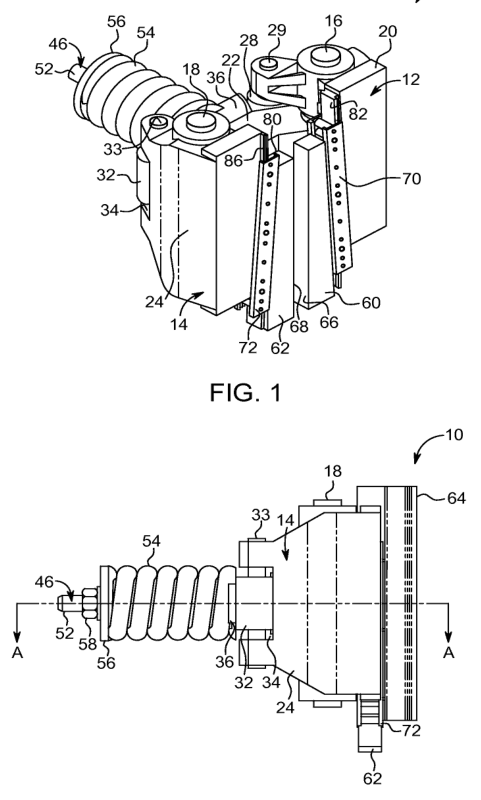
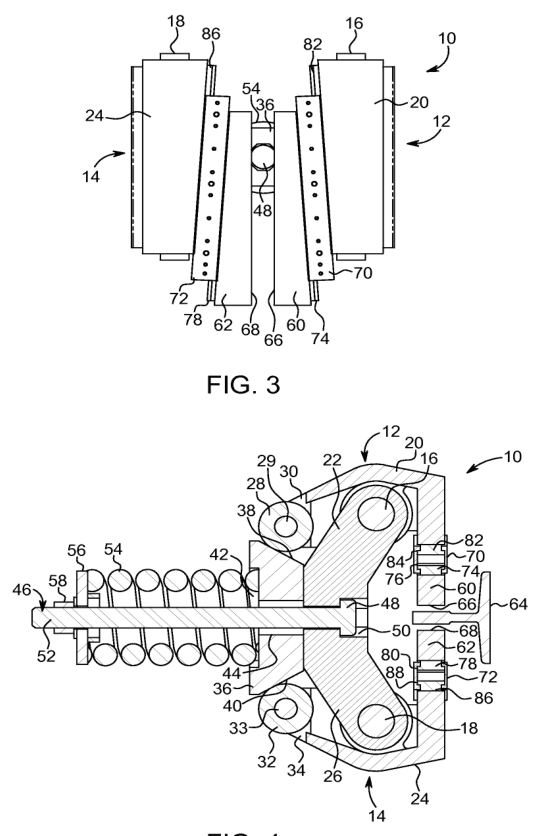
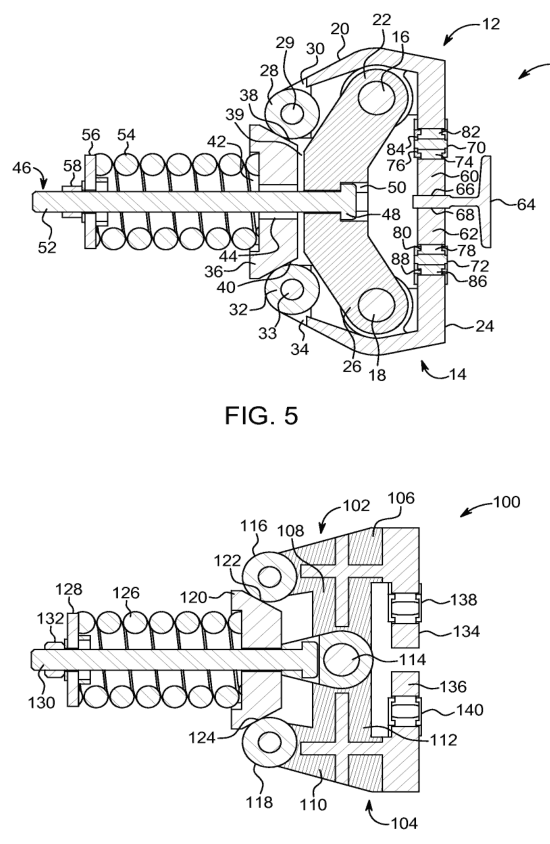
(57) What the patent covered
This write-up was generated by AI from the patent's text and may contain mistakes, so check it against the original patent before relying on it.
The main independent claim requires at least two lever arms pivoting about respective pivot points, each lever arm having a wedge at one end and a roller at the other, a cam member located between the rollers pressing against an inner body, and a resilient member bearing against the cam; when the wedges move substantially parallel to the guide-rail axis the rollers push the cam toward the resilient member, compressing the resilient member and creating a gap between the inner body and the cam.
Distinguishing feature: A cam located between rollers on opposing lever arms that is pushed by both rollers to compress a resilient member and deliberately create a gap between the cam and an inner body during wedge-driven clamping.
Novelty 3/5. Lever-arm wedge clamping and resilient cushions were common for elevator safety gears; the new detail is the cam-between-rollers arrangement that shifts load to compress a spring and open a gap during actuation.
Manufacturing
Machined or forged steel lever arms and inner body; turned and heat-treated wedges and cam; off-the-shelf roller bearings; spring manufactured by coiling and heat treatment; assembly with pins/pivots and press-fit or bolted subassemblies.
Materials: Hardened steel lever arms and wedges, roller bearings (steel), machined steel cam and inner body, high-rate steel spring or elastomeric resilient member.
Manufacturability 4/5. Several stamped/forged/machined metal parts, standard bearings and a spring require medium-level tooling and controlled assembly of pivots and clearances; no electronics but moderate precision in mating surfaces and pivots is needed.
Market demand
No demand check has been run for this patent. Likely search terms: elevator safety jaw, guide rail clamping jaw, safety gear wedge clamp. The links in the sidebar open these searches.
Buyers: Elevator manufacturers, maintenance contractors, elevator parts suppliers.
Before manufacturing
No related continuation or divisional patents in force were found. Design patents, trademarks and unrelated patents may still cover the product.
Patent lapsed; check product meets elevator safety standards (e.g., EN 81, ASME A17.1) and verify material heat treatment and dimensional tolerances for high-speed, high-load applications.
About 1.5% of lapsed patents are later revived by their owners. This page is a research lead, not legal advice. Obtain a freedom-to-operate opinion before manufacturing.