Handheld pivoting cutter for trimming surgical pins, rods and anchors
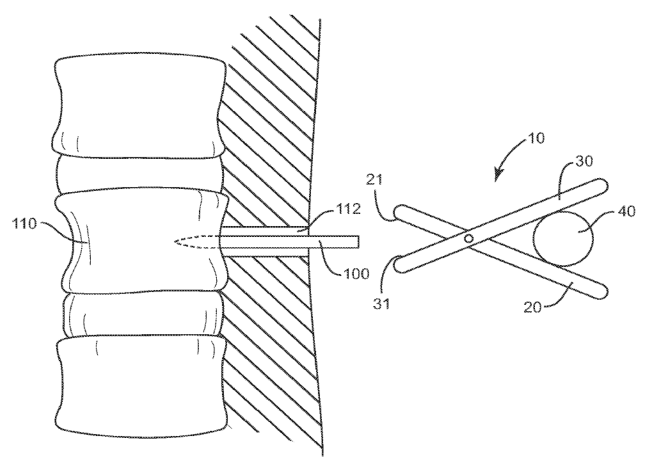
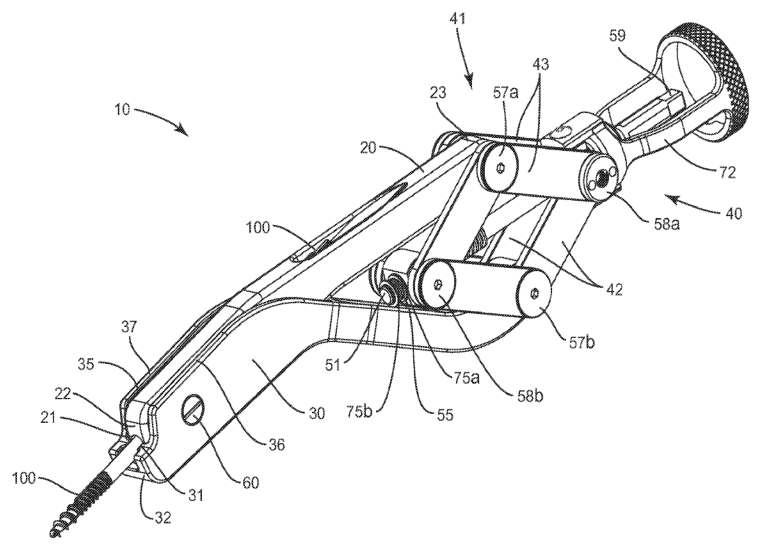
A compact handheld surgical cutter with two elongated pivoting arms and opposing cutting elements at the distal ends, intended to trim excess portions of implanted or pre‑assembled elongated orthopedic elements (pins, rods, bone‑anchor shafts). A longitudinal passage formed by an aperture in one arm and a matching aperture in a pivot member aligns the element in a channel in the other arm while a force mechanism at the proximal ends closes the blades to sever the element. Typical users are orthopedic surgeons and OR technicians during implant procedures or implant preparation.
(57) What the patent covered
This write-up was generated by AI from the patent's text and may contain mistakes, so check it against the original patent before relying on it.
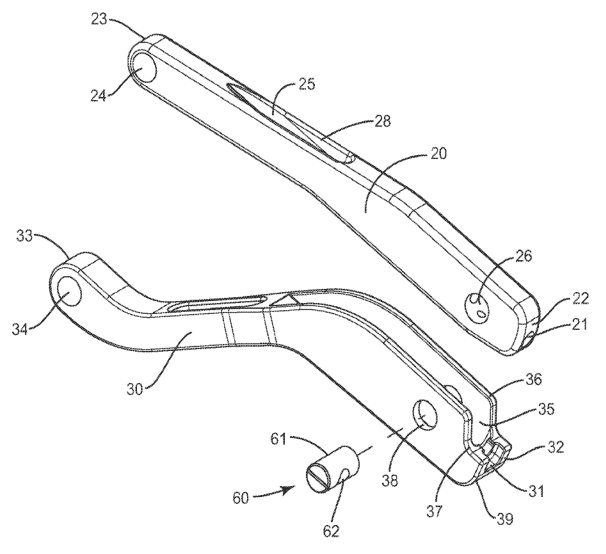
The independent claim required two elongated arms with distal cutting elements, the first arm having a longitudinal inlet‑to‑outlet aperture through its distal section, the second arm having spaced walls forming a longitudinal channel that receives an overlapping distal section of the first arm, a pivot member fixed to the first arm and movable relative to the second arm with a second aperture aligning with the first aperture to form a passage for the elongated element, and a force mechanism attached to the proximal arm sections to pivot the arms between open and closed cutting orientations.
Distinguishing feature: A built‑in longitudinal passage through the overlapping distal sections formed by an aperture in one arm and an aligning aperture in the pivot member, combined with the channeled second arm that captures the first arm, reducing overall instrument size while allowing the cut to be made in‑situ.
Novelty 3/5. Capturing one cutter blade inside a channel in the opposing arm and using a pivoting two‑arm shear is a familiar mechanism for cutters; the patent emphasized an integrated aperture/pivot‑aperture passage and compact force mechanism placement as the differentiating detail.
Manufacturing
CNC‑machined or stamped and finish‑ground stainless steel arm halves, heat treat and edge grinding for blades, assembly of pivot member and pivot pin, insertion of force mechanism (spring or ratchet) and final passivation; limited hand assembly for alignment and testing.
Materials: Stainless steel (surgical grade), hardened stainless cutting edges, stainless pivot pin or machined pivot member, polymer or metal force‑mechanism components (springs, coiled torsion or compression).
Manufacturability 4/5. Several machined or stamped stainless parts with precision blade surfaces and a pivot assembly; requires blade grinding and assembly but no electronics or custom tooling beyond standard surgical instrument tooling.
Market demand
No demand check has been run for this patent. Likely search terms: surgical rod cutter handheld, orthopedic pin trimmer instrument, bone anchor cutting tool. The links in the sidebar open these searches.
Buyers: Orthopedic surgeons and hospital surgical instrument buyers.
Before manufacturing
No related continuation or divisional patents in force were found. Design patents, trademarks and unrelated patents may still cover the product.
Claims focus on the specific aperture/pivot‑aperture passage and channeled overlapping distal arm geometry; market has many general orthopedic cutters and there may be regulatory requirements (STERILIZATION, ISO 13485) for surgical instruments.
About 1.5% of lapsed patents are later revived by their owners. This page is a research lead, not legal advice. Obtain a freedom-to-operate opinion before manufacturing.