Handheld medical drill with a bendable distal drill unit
A handheld medical motor drill whose distal drill unit bends relative to the shaft to allow angled drilling while the operator holds the proximal main body. The device transmits drive power from the main body to a distal motor and includes a drive-force transmission assembly and an angle adjustment unit that sets the bending degree; the shaft can be rotated about its longitudinal axis. Intended users are surgeons performing thoracic or rib fixation procedures where access angles are limited.
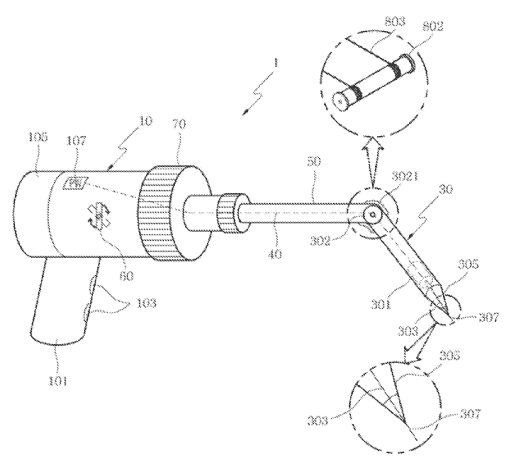
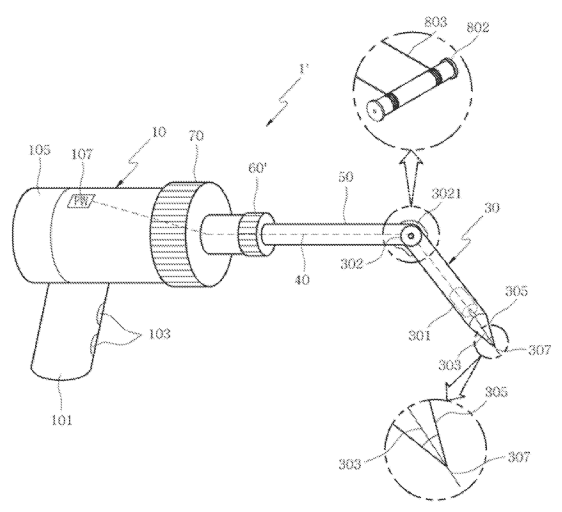
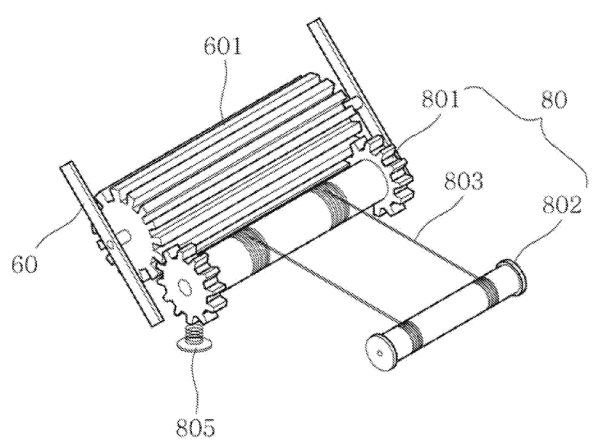
(57) What the patent covered
This write-up was generated by AI from the patent's text and may contain mistakes, so check it against the original patent before relying on it.
The main independent claim covered a handheld medical drill having: a main body; a shaft connected to the main body; a bendable drill unit at the distal end containing a motor that receives power from the main body and a drill blade rotated by that motor; a drive-force transmission unit that bends the drill unit relative to the shaft; an angle adjustment unit coupled to the drive-force transmission unit to set the bend angle; and a rotation-adjustment unit coupling the shaft to the main body to rotate the shaft about its longitudinal axis.
Distinguishing feature: The distal drill unit houses its own motor and is bendable via a drive-force transmission and an external angle-adjustment unit allowing the operator to set distal angle without moving the proximal handle.
Novelty 3/5. At filing, powered surgical drills and articulated end effectors existed; the patent combined a distal motorized drill head that is mechanically bendable and an external angle-adjustment mechanism to permit angled drilling from a fixed proximal grip, which was a nontrivial improvement on familiar rigid motor drills.
Manufacturing
Likely produced by machining stainless-steel components for the drill blade and torque shafts, manufacturing articulated shaft segments or flexible torque cable, injection molding polymer housings for the main body and adjustment knobs, and assembly of electrical wiring and small DC motor into the distal unit with hand or automated assembly.
Materials: Stainless steel drill blade and distal housing (likely), Flexible or articulated shaft sections (steel or alloy), Internal drive elements such as helical shafts or Bowden-type cable (steel cable or torque shaft), External adjustment knobs or gears (machined metal or injection-molded polymer).
Manufacturability 4/5. Several machined metal parts (motor, drill blade, torque shaft), molded plastic housings, and wired electrical assembly are required; assembly includes routing power to a distal motor and integrating the angle-adjustment linkage but uses common medical-device manufacturing operations.
Market demand
No demand check has been run for this patent. Likely search terms: bendable medical drill, articulating surgical drill, angled thoracic drill. The links in the sidebar open these searches.
Buyers: Thoracic and trauma surgeons or hospitals performing rib fixation.
Before manufacturing
No related continuation or divisional patents in force were found. Design patents, trademarks and unrelated patents may still cover the product.
Potential regulatory and sterilization requirements for powered surgical instruments and the need to route power to a distal motor are practical risks; patent lapsed but device-space may be crowded.
About 1.5% of lapsed patents are later revived by their owners. This page is a research lead, not legal advice. Obtain a freedom-to-operate opinion before manufacturing.