Encrypted aggregation in a star network using encrypted polynomial shares
A protocol for private aggregation where each participant sends multiple ciphertexts that encode polynomial shares of its input; a central aggregator homomorphically combines shares by recipient, returns per-recipient encrypted partials, participants decrypt and return partials, and the aggregator reconstructs the global aggregate from a subset of decrypted partials. It targets scenarios where endpoints do not peer (star topology) and privacy requires endpoints not learn others' inputs.
(57) What the patent covered
This write-up was generated by AI from the patent's text and may contain mistakes, so check it against the original patent before relying on it.
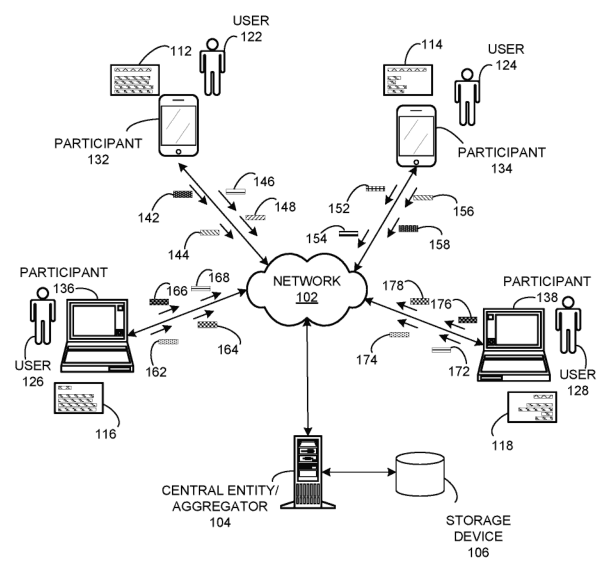
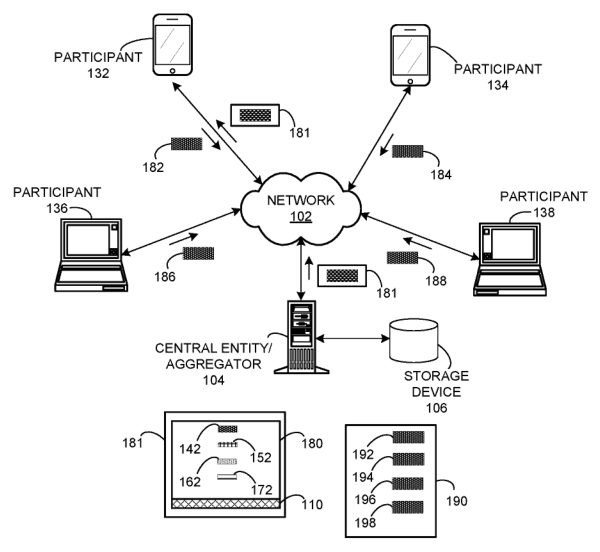
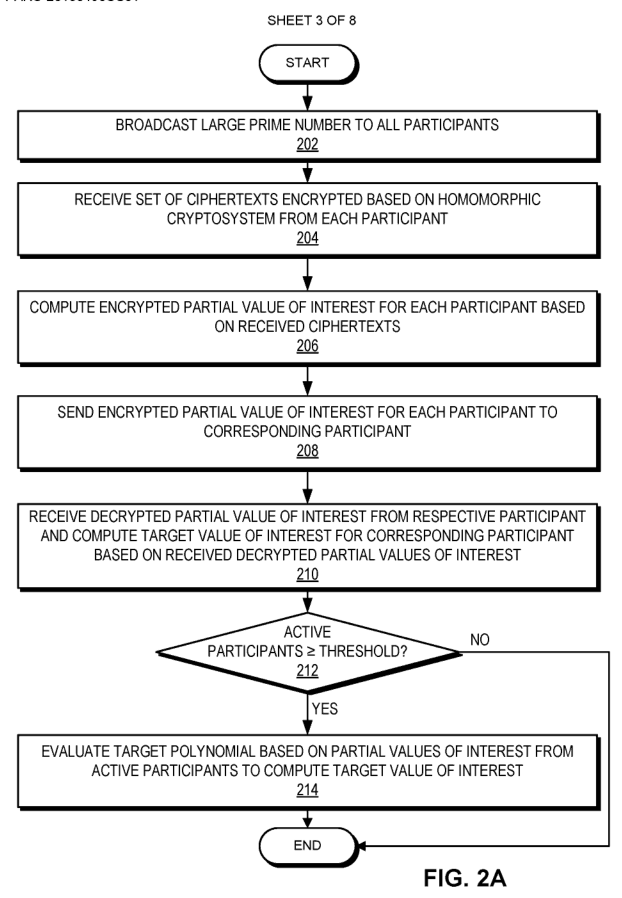
The main independent claim covers a computer method and system that: receives, from each participant, a set of ciphertexts that are encrypted polynomial shares of that participant's input and each ciphertext is tagged to a specific recipient; computes for each participant an encrypted partial value by homomorphically aggregating ciphertexts associated with that participant and encrypting that partial under the participant's public key; sends each encrypted partial to its participant; receives decrypted partials back; and computes a target aggregate from a subset of the decrypted partials.
Distinguishing feature: Using per-recipient encrypted polynomial shares and homomorphic aggregation at the central node to produce per-recipient encrypted partials that participants decrypt to enable fault-tolerant reconstruction in a star network.
Novelty 3/5. At filing time, homomorphic aggregation and secret-sharing were known; the patent combines per-recipient polynomial shares with central homomorphic combining to handle a star topology and tolerate missing participants, which is a practical improvement on known secure aggregation methods.
Implementation
A small team would implement this by using an additively homomorphic encryption scheme (Paillier or elliptic-curve ElGamal with appropriate group), or secret-share polynomials over a finite field; each client generates polynomial shares for every recipient, encrypts each share under that recipient's public key, and sends the bundle to the aggregator; the aggregator homomorphically adds the ciphertexts per recipient to produce encrypted partials, returns these to recipients, recipients decrypt and return plaintext partials, and the aggregator reconstructs the aggregate from a threshold subset (implement threshold reconstruction and missing-party handling in server logic).
Components: Central aggregator server with homomorphic-capable crypto library, participant devices (microcontrollers, phones) with public/private key pairs, network transport (TLS) for ciphertext exchange, finite-field arithmetic and polynomial-share routines.
Buildability 5/5. The engineering work is standard crypto and networking; the main work is correct finite-field/share bookkeeping, key management, and selecting/implementing a homomorphic primitive with acceptable performance.
Market demand
Comparable products exist; none doing exactly this was found. Several open-source efforts exist leveraging Bonawitz-style secure aggregation, pairwise masking, and encrypted shares; active research area with multiple independent implementations; competition and consolidation ongoing.
- SAFE (Secure Aggregation with Failover and Encryption) · CableLabsfree
- secure-aggregation (Federated Learning with Enclaves) · mc2-projectfree
- fl_secure_aggregation_zkp (Secure aggregation with zero-knowledge defenses) · bamb00boyfree
Demand check by web search, week of Oct 12, 2026. Listings change frequently.
Buyers: Utilities, healthcare analytics platforms, IoT fleet operators.
Before manufacturing
No related continuation or divisional patents in force were found. Design patents, trademarks and unrelated patents may still cover the product.
Performance and bandwidth cost of sending O(n) shares per participant and key management; related literature and patents in secure aggregation and homomorphic sums may cover similar approaches (not legal advice).
About 1.5% of lapsed patents are later revived by their owners. This page is a research lead, not legal advice. Obtain a freedom-to-operate opinion before manufacturing.