Personalized sandwich recipes from past orders and feedback
System builds a per-patron taste profile from past order contents and explicit taste feedback, then modifies standard recipes for new orders and submits personalized recipes to a robotic food assembler. Restaurants or robotic-assembly operators and ordering-app providers would use it to automate individualized ingredient amounts and assembly timing.
(57) What the patent covered
This write-up was generated by AI from the patent's text and may contain mistakes, so check it against the original patent before relying on it.
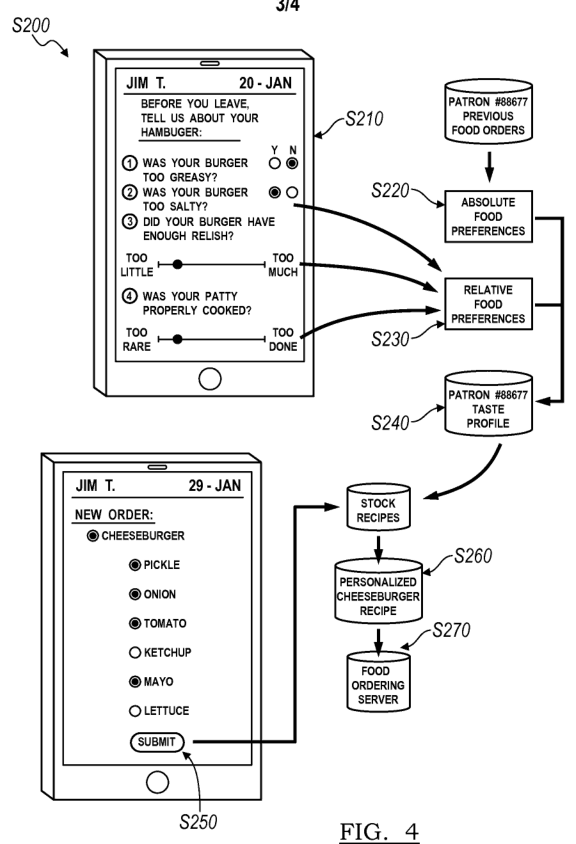
The main independent claim covers: retrieving a patron's past orders and feedback; calculating an absolute preference (inclusion/omission trends) and a relative taste preference (preferred percentage difference from standardized ingredient amounts); generating a taste profile from those preferences; applying that profile to a standard recipe for a newly selected item to produce a personalized recipe that specifies target ingredient amounts; and sending that recipe to a food assembly apparatus or controlling its actuators to assemble the item.
Distinguishing feature: Combining historical inclusion/omission trends with explicit feedback expressed as percent-differences from standard recipe ingredient amounts, and applying both to modify recipes for different menu items for robotic assembly.
Novelty 3/5. Personalization from past orders and feedback was known; the patent emphasized calculating percentage-based relative preferences and applying them across different menu items, which was a concrete improvement on common preference-tracking systems.
Implementation
A small team would implement a cloud service that ingests order history and explicit feedback, computes absolute (ingredient include/omit) and relative (percentage multipliers per ingredient) preferences, stores a taste profile per user, applies multipliers to standard recipe ingredient quantities for new orders, and emits JSON recipes to a kitchen robot API or a human-facing production dashboard. Use a relational DB, simple ML/heuristics for trend detection, REST APIs, and a message queue to submit build jobs.
Components: Ordering application (mobile or web), Database of prior orders, standard recipes, and patron feedback, Taste-profile computation module (server-side), Robotic food assembly apparatus or actuator control interface.
Buildability 5/5. Main work is software and integrations: building reliable mappings between recipe ingredient units and robot actuators, and collecting sufficient feedback data for stable multipliers.
Market demand
No demand check has been run for this patent. Likely search terms: personalized food recipe engine, order-history taste profile, robotic kitchen recipe personalization. The links in the sidebar open these searches.
Buyers: Quick-service restaurants, automated kitchens, ordering platform operators.
Before manufacturing
No related continuation or divisional patents in force were found. Design patents, trademarks and unrelated patents may still cover the product.
Product requires accurate mapping of recipe ingredient units to dispensing actuators and sufficient user feedback; market is crowded with personalization approaches and integration with third-party kitchen robotics may be complex.
About 1.5% of lapsed patents are later revived by their owners. This page is a research lead, not legal advice. Obtain a freedom-to-operate opinion before manufacturing.