Self‑checkout that detects slow scanning or errors and routes customer
A self‑service POS captures customer identity (card or face), measures the customer’s scan rate and detects error conditions, and then triggers predefined actions such as routing the transaction to an attendant lane or invoking assistance without human initiation. The system includes a camera, optical scanner, terminal and server communicating user and scan data and stored customer profiles. Retailers operating mixed staffed and self‑checkout lanes use it to reduce stalled lanes and manage exceptions.
(57) What the patent covered
This write-up was generated by AI from the patent's text and may contain mistakes, so check it against the original patent before relying on it.
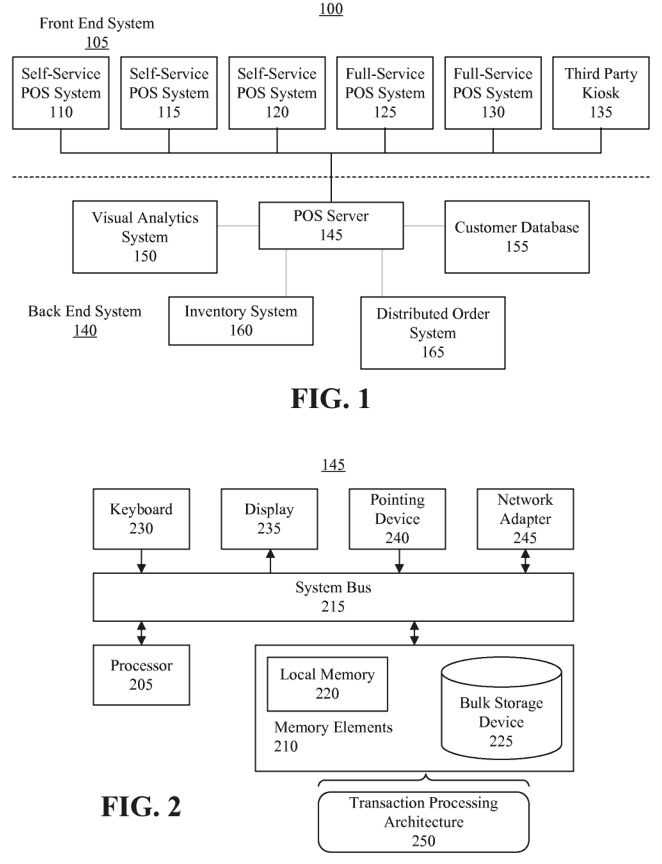
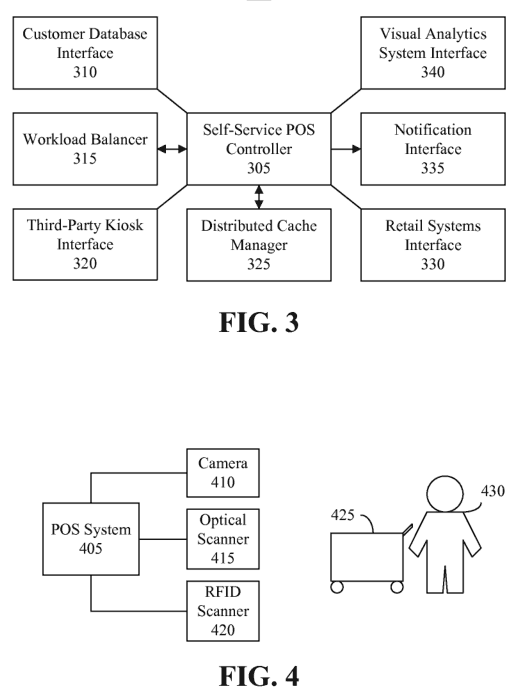
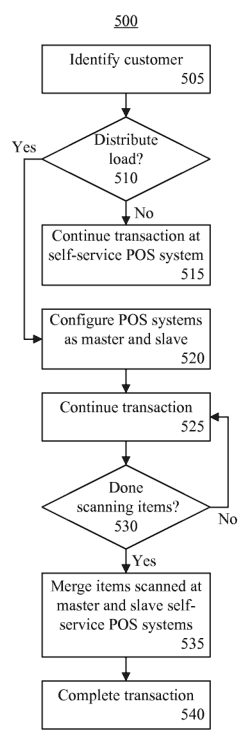
The independent claims covered a self‑service POS terminal with a camera and optical scanner connected via a terminal bus to a networked POS server that stores customer data; the server’s processor must identify the customer (at least in part with facial recognition), determine the customer’s scan rate from scanner data, compare that rate or detect an error condition, and initiate actions such as transferring the transaction to another POS without human intervention.
Distinguishing feature: Combining customer identification (including facial recognition) with real‑time scan‑rate measurement at self‑checkout to trigger automated transaction transfers or interventions.
Novelty 3/5. At filing time (circa 2012) self‑checkout, scanner error detection and basic camera monitoring were common; the patent added the specific coupling of ID/face recognition plus scan‑rate thresholds to automate routing decisions.
Implementation
A small team would deploy an off‑the‑shelf POS terminal running a kiosk application (Electron or native), integrate a USB camera and USB/RS‑232 scanner to emit timestamped scan events, and send camera frames and scan events to a cloud or edge service. The service uses an open‑source face recognition library to map faces to stored profiles, computes moving scan‑rate (items per minute) and error flags, and triggers REST/websocket actions to prompt the terminal UI or call an attendant app to accept a transferred transaction.
Components: Self‑service POS terminal (touchscreen PC or embedded Linux device), Camera (visible‑light webcam) for lane imaging and face detection, Optical barcode scanner (handheld or fixed‑mount) with scan event stream, Backend POS server or cloud service with customer database and rules engine, Network (Ethernet/Wi‑Fi) and message bus between terminal and server.
Buildability 5/5. Main work is software integration: reliable face matching, low‑latency scan event processing, and store integration with attendant consoles and POS back‑end.
Market demand
Comparable products exist; none doing exactly this was found. Multiple vendors offer AI-powered self-checkout monitoring and attendant-routing capabilities; market includes NCR/RDS solutions, AI lane monitoring startups (Lexius, Retellect), and vision-based/shrink-reduction vendors; growing interest in real-time intervention and loss prevention at self-checkout lanes.
- NCR Voyix Self-Checkout (FastLane SelfServ) with attendant oversight · NCR / RDS POSnull
- Lexius Lane AI – AI-based self-checkout monitoring and intervention · Lexiusnull
- Retellect – Self-checkout loss prevention & product selection monitoring · Retellectnull
Demand check by web search, week of Oct 12, 2026. Listings change frequently.
Buyers: Grocery and big‑box retail operations.
Before manufacturing
No related continuation or divisional patents in force were found. Design patents, trademarks and unrelated patents may still cover the product.
Privacy and biometric laws, camera consent, and operational false positives are practical risks; market solutions already offer overlapping functionality.
About 1.5% of lapsed patents are later revived by their owners. This page is a research lead, not legal advice. Obtain a freedom-to-operate opinion before manufacturing.