Form-level secure-submission indicator and enforcement
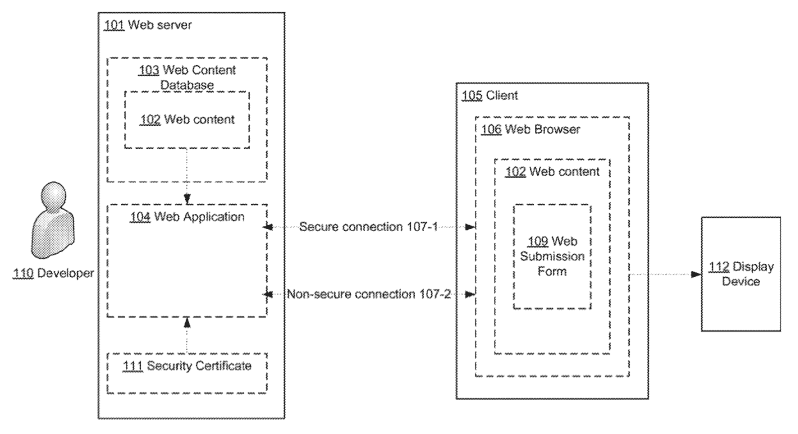
The patent describes a browser-side mechanism that reads a security attribute on HTML forms, checks the form action URL and the server TLS certificate, and then allows or blocks submission based on those checks while presenting a visible indicator (for example a lock) before submission. It is for web clients (browsers or browser extensions) and web servers that want clients to signal or enforce that a given form will POST over a secure channel and to verify the destination certificate prior to sending credentials or payment data.
(57) What the patent covered
This write-up was generated by AI from the patent's text and may contain mistakes, so check it against the original patent before relying on it.
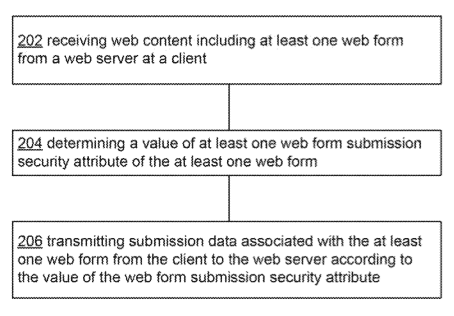
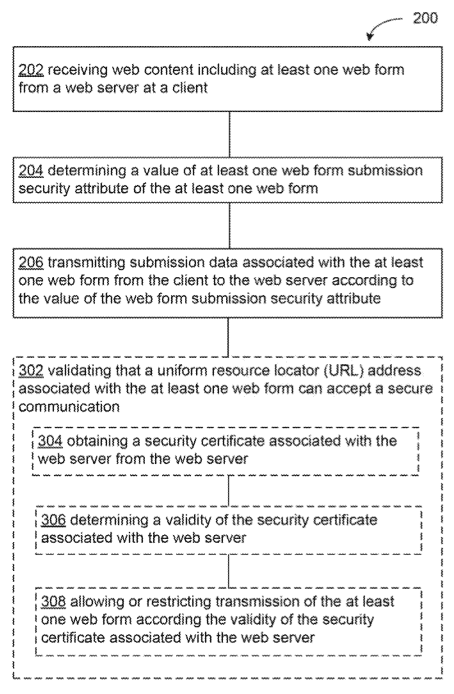
The main independent claim required: receiving a page containing a web form that includes at least one security attribute (a binary HTML attribute indicating whether the connection for submission should be secure); processing that attribute; obtaining the server TLS certificate; validating the certificate; checking that the form's URL accepts secure communication and checking if the submission URL differs and whether it accepts secure communication; and then allowing or restricting transmission of the form data according to the attribute value and certificate validity.
Distinguishing feature: Introducing a form-level "secure" attribute plus client-side pre-submission checks of the form action URL and server certificate and a visible indicator shown before form submission.
Novelty 3/5. Browsers already used HTTPS and showed page-level lock icons; the novelty is a form-level security attribute and enforcement prior to submission rather than only the page-level lock.
Implementation
A small team would implement this as a browser extension or in-page script that intercepts form submissions, reads a custom secure attribute on <form>, resolves and normalizes the form action URL, performs an HTTPS connection attempt or TLS certificate fetch to validate the destination certificate, and then blocks or allows the submit while updating a small lock icon in the page UI; use existing TLS libraries and the browser's CORS and certificate APIs where available.
Components: Browser rendering engine or browser extension, HTML parser that reads form attributes, TLS certificate validator (OS/browser store), UI element to display a secure/unsecure indicator.
Buildability 5/5. The engineering is straightforward; the harder parts are coordinating certificate checks across origins and producing reliable UX without breaking legitimate cross-origin AJAX forms.
Market demand
Comparable products exist; none doing exactly this was found. Major browser vendors (Mozilla, Brave) offer built-in, user-enabled HTTPS upgrade modes; third-party extensions exist to enforce HTTPS across sites. This space shows consumer demand for stronger form/posting security signals at the client level, though explicit per-form indicators or pre-submission lock indicators are less commonly exposed as standalone products today.
- HTTPS-Only Mode · Mozilla Firefoxfree
- Strict HTTPS Upgrade (Upgrade to HTTPS by default) · Brave Browserfree
- Force HTTPS (SSL/TLS) – Chrome Web Store extension · Chrome Web Store (independent extension)free
Demand check by web search, week of Oct 12, 2026. Listings change frequently.
Buyers: Web application operators and browser-extension users handling credentials or payments.
Before manufacturing
No related continuation or divisional patents in force were found. Design patents, trademarks and unrelated patents may still cover the product.
Practical risks include cross-origin submission patterns (CORS/AJAX), mixed-content policies, and user experience friction; the patent lapsed so no licensing barrier is noted here.
About 1.5% of lapsed patents are later revived by their owners. This page is a research lead, not legal advice. Obtain a freedom-to-operate opinion before manufacturing.