Wheeled walker with tethered belt to limit separation
A four‑wheeled rollator-style walker with an integrated belt and one or more tethers that attach the user to the frame to limit how far the walker can move away. The tether assembly includes a webbing/buckle portion and an elastic segment that yields progressively beyond a slack length; an alternative tether configuration uses a buckle designed to break away if tension exceeds a threshold. Intended users are clinic or home patients with gait impairment such as Parkinson’s disease.
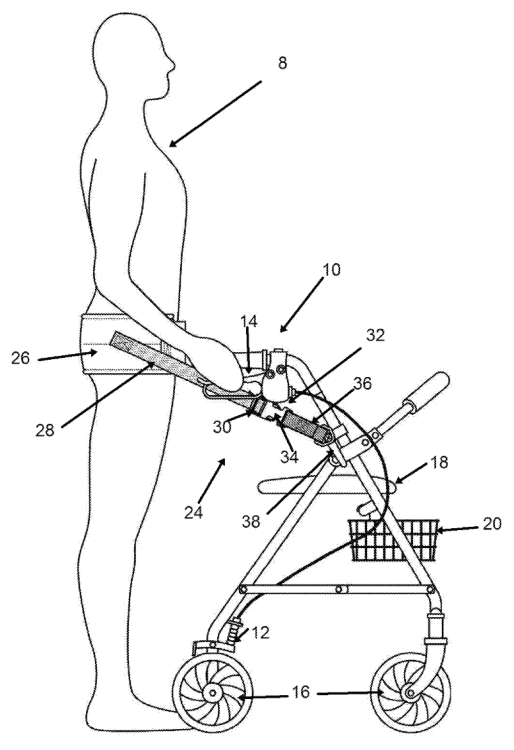
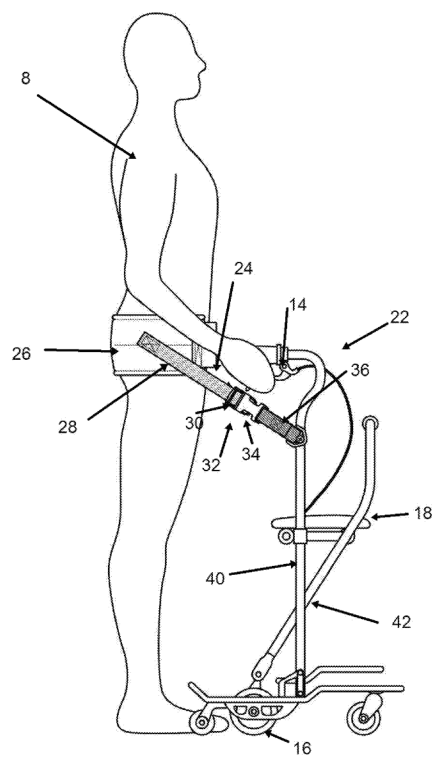
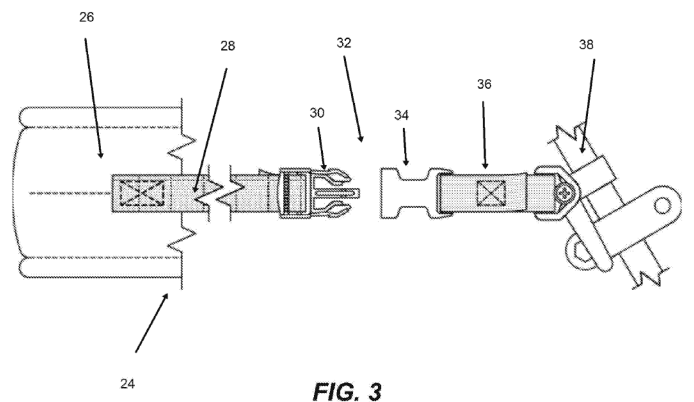
(57) What the patent covered
This write-up was generated by AI from the patent's text and may contain mistakes, so check it against the original patent before relying on it.
The main independent claim covered a wheeled walker having a belt for attachment to a person and at least one elongate tether between the frame and the belt where each tether includes a buckle with two cooperating releasable components, a strap webbing connected between the belt and the first buckle component, and an elastic portion between the frame and the second buckle component so the elastic portion provides proportional tension beyond a slack distance. An alternative independent claim required the buckle components to be configured to break away when tether tension exceeds a threshold.
Distinguishing feature: Integration of a belt/tether assembly with both a nonrigid elastic segment that yields proportionally beyond slack and a buckle that can be configured to break away, built into a wheeled walker.
Novelty 3/5. Wheeled walkers and user belts were common; the patent combined a tether with a defined elastic slack/tension behavior and an optionally breakaway buckle to address walker separation during freezing episodes.
Manufacturing
Stamped/tube-formed metal frame, injection-molded plastic buckle components, cut/heat-sealed strap webbing, overmolded or sewn connection to belt, hand or automatic assembly of tether to frame and belt.
Materials: Nylon or polyester strap webbing, elastic rubber or elastomeric cord/sleeve, injection-molded plastic buckle components (acetal or nylon), steel or aluminum walker frame components.
Manufacturability 4/5. Design uses several simple parts (frame, webbing, elastic segment, buckles) with routine assembly; requires sourcing of standard buckles and elastic and attachment/fastening to the walker frame and belt.
Market demand
Comparable products are on sale; this exact design was not found. US-based safety walker concept with a belt/strap system; rental model described; clinical/home-use positioning.
- Safety Walker (Indee Mobility) – fall-catch belt system integrated... · Safety Walker / Indee MobilityRental: $5 per day (7-day minimum); In-home trial: $50
Demand check by web search, week of Oct 12, 2026. Listings change frequently.
Buyers: Clinics, caregivers and patients with Parkinson’s or gait freezing.
Sourcing
Factories list related products that could be adapted, at about $50.00–$75.00 per unit with a typical minimum order of 1 unit. These listings are related to walkers/rollators and safety restraint components; explicit tether belt assemblies for rollators are not clearly shown, but the suppliers indicate OEM/ODM capabilities and related rehabilitation walker products—useful as potential manufacturers for a tether belt integration or private-label development.
- XIAMEN DORRELLA HEALTH TECHNOLOGY CO.,LTD · Made-in-China.com (Dorrella Health Technology) · MOQ 1US$50.00 per piece
- Walker On Water Factory (Made-in-China.com) · Made-in-China.com · MOQ 100US$70.00 - 75.00 per piece
- Fixed Walker Factory (Made-in-China.com) · Made-in-China.com · MOQ 1US$76.80 - 77.20 per piece
Supplier prices are from public listings found by web search, quoted before customization, shipping and duties. Use them to decide whether to request a quotation.
Before manufacturing
No related continuation or divisional patents in force were found. Design patents, trademarks and unrelated patents may still cover the product.
Practical issues include user comfort and fit of the belt, strength and fatigue life of elastic and buckles, and potential liability or device regulation depending on marketing claims; patent has lapsed.
About 1.5% of lapsed patents are later revived by their owners. This page is a research lead, not legal advice. Obtain a freedom-to-operate opinion before manufacturing.