Gravity-fed roller tray with snap-on cover
A shallow tray with rows of short rotating rollers that feed articles forward on a sloped display rack. A base with an upstanding peripheral wall holds roller shafts; a plate-like cover snaps to the wall so roller surfaces protrude through holes. Typical users are retail fixture makers and convenience-store display suppliers.
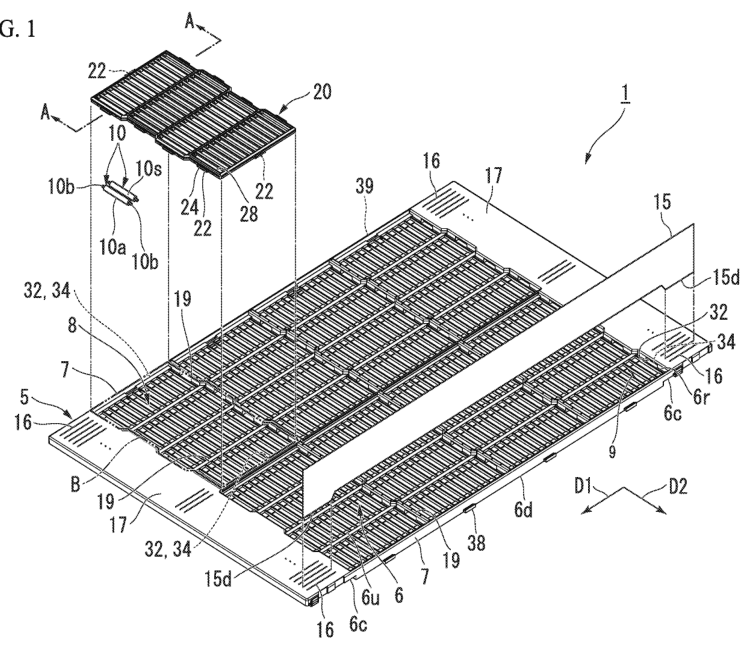
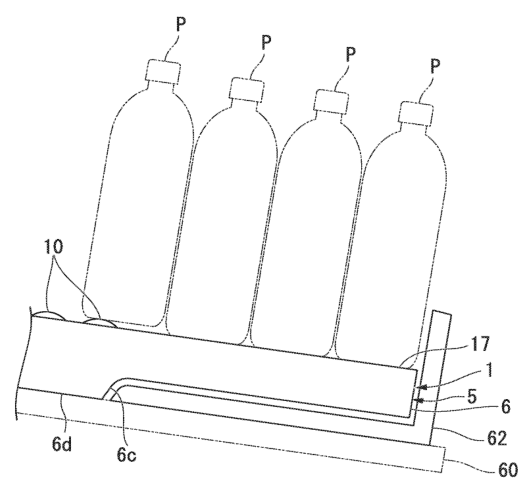
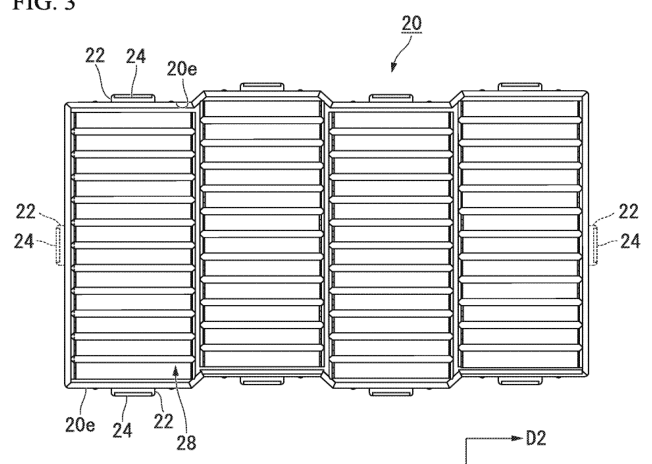
(57) What the patent covered
This write-up was generated by AI from the patent's text and may contain mistakes, so check it against the original patent before relying on it.
The independent claim required a base with a bottom plate and peripheral wall that rotatably holds multiple roller members, plus a detachable plate-shaped cover that covers the wall opening while leaving roller surfaces protruding, where the base is formed of a material meeting specified mechanical-property ranges (flexural modulus 2,500–4,000 MPa and two compound parameters computed from modulus, yield stress, thickness, density and tensile strain at break within 7.00–18.00 and 2.00–10.00).
Distinguishing feature: The claimed novelty was specifying the base material by numerical mechanical-property ranges and two compound parameters tied to modulus, yield stress, thickness, density and tensile strain at break.
Novelty 3/5. Roller-fed gravity feed trays were common; the patent added a specific material-property envelope for the base to address stiffness, strength and stretch behavior rather than new mechanical geometry.
Manufacturing
Injection-mold the base and cover from the specified engineering plastic(s); mold rollers (extrude-cut or injection-mold HDPE/acetals) and install on metal shafts; assemble rollers into base by press-fitting shafts into holes; snap-fit cover onto peripheral wall; final packaging.
Materials: Thermoplastic polymer with flexural modulus 2,500–4,000 MPa (likely ABS or PC/ABS blend), Reinforced injection-moldable polymer (likely glass-filled nylon), Low-friction roller material (polyethylene, acetal, or nylon), Stamped or molded metal shaft (steel).
Manufacturability 4/5. Parts are mostly molded and stamped with snap-fit assembly; requires tooling for injection molds and press-fit tolerances for roller shafts but no electronics or precision optics.
Market demand
This design, or something very close to it, is on sale now. Major manufacturers market gravity-feed roller shelf solutions in the US with notes on facings and efficiency; some listings include planograms, NSF-related claims, and quotes rather than published street prices.
- @Front gravity-feed roller shelving system · Madix, Inc.
- VersaRollerShelf gravity roller shelving · Griffin Industries
- FlexRoller gravity feed roller system · FlexRoller (via FlexRoller/Bruegmann group)
Demand check by web search, week of Oct 12, 2026. Listings change frequently.
Buyers: Retail fixture manufacturers and convenience-store display suppliers.
Sourcing
Factories list this type of product on supplier marketplaces. Found manufacturers offering gravity/roller feed shelf components and related systems; no specific unit prices or MOQs publicly listed—pricing typically provided on quote.
- kostklip · https://kostklip.comnot listed
- OFL Roller Shelf (OFL Shelf Systems) · https://www.oflrollershelf.comnot listed
- GLD Display · https://www.gld-display.comnot listed
Supplier prices are from public listings found by web search, quoted before customization, shipping and duties. Use them to decide whether to request a quotation.
Before manufacturing
No related continuation or divisional patents in force were found. Design patents, trademarks and unrelated patents may still cover the product.
Patent lapsed; pay attention to meeting the specified material-property parameters in product literature if invoking this design detail; risks include crowded market for gravity-feed trays and ensuring snap-fit durability for repeated shelf restocking.
About 1.5% of lapsed patents are later revived by their owners. This page is a research lead, not legal advice. Obtain a freedom-to-operate opinion before manufacturing.