Field cultivator with shanks that pivot ≥70° for folding
A field cultivator frame carries multiple shanks that are pivotably mounted to fold from an operating position to a folding position by pivoting at least 70° about their pivot axis. Each shank includes a defined locking portion that mates with a chassis-mounted locking mechanism; the mechanism can be switched between a coupling position that locks aligned shanks against pivoting and a non‑coupling position that allows shanks to pivot for folding. Intended users are farmers and equipment manufacturers who need transportable cultivators with reduced folded width.
(57) What the patent covered
This write-up was generated by AI from the patent's text and may contain mistakes, so check it against the original patent before relying on it.
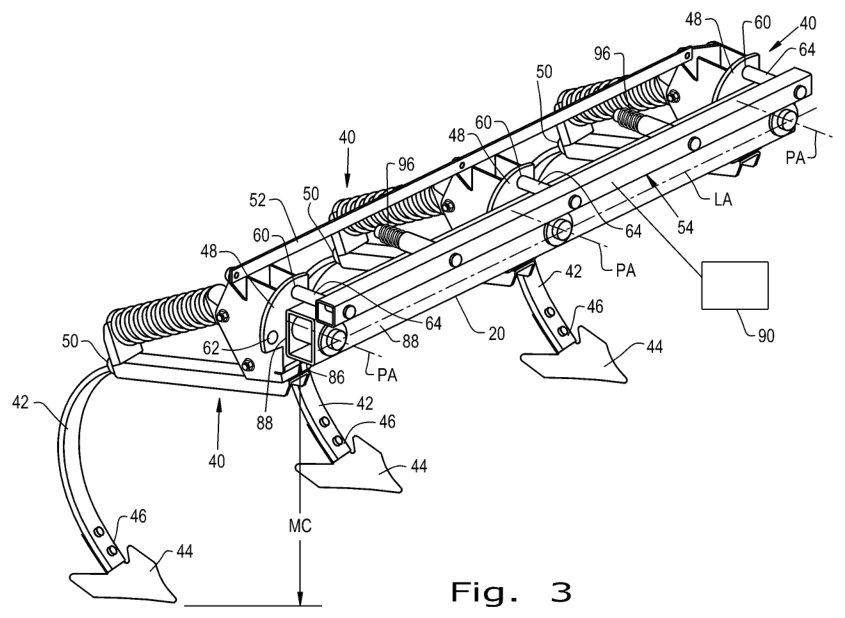
The main independent claim covers an agricultural implement having a chassis and frame with one or more shanks pivotably mounted; each shank has a locking portion with a shank locking feature, and the chassis carries a locking mechanism with a shank coupling feature that selectively couples to the shank locking feature to prevent pivoting in a coupling position and permits pivoting in a non‑coupling position. The shanks pivot at least 70° between operating and folding positions (description states pivoting at least 70°).
Distinguishing feature: A chassis‑carried, selectively actuated locking mechanism that couples to a shank locking feature so shanks can be locked for operation or released to pivot (≥70°) into a folded transport position.
Novelty 3/5. Pivotable cultivator shanks and folding wings were common; the patent focuses on a particular chassis‑mounted selective coupling mechanism and a large pivot range (≥70°) as an improvement on familiar folding cultivators.
Manufacturing
Fabricated steel chassis and frame (plate and welded box sections), stamped or machined shank bodies and locking portions, heat treat/harden wear surfaces, assemble with pins/hinges and install actuating linkage or hydraulic cylinders; final assembly and calibration.
Materials: Welded steel frame and chassis, hardened steel shank and locking plate, springs or hydraulic/pneumatic actuator for locking mechanism (likely), fasteners (bolts, pins).
Manufacturability 4/5. Standard agricultural implement construction: welded steel subassemblies, stamped/machined shanks, pinned hinge joints and a modular locking actuator; several simple parts and routine assembly are required.
Market demand
Comparable products are on sale; this exact design was not found. Field cultivators with foldable wings and transport locks are demonstrated in manufacturer manuals and product pages; e.g., Landoll 9650 includes wing transport locks and folding sequence details; KUHN 5640 page lists foldable wing configurations.
- Landoll 9650 Field Cultivator · Landoll Corporation
- KUHN 5640 Field Cultivator · KUHN USA
Demand check by web search, week of Oct 12, 2026. Listings change frequently.
Buyers: Farmers, implement dealers, agricultural equipment OEMs.
Before manufacturing
No related continuation or divisional patents in force were found. Design patents, trademarks and unrelated patents may still cover the product.
Claim scope centers on the specific shank locking feature and chassis‑mounted coupling mechanism and on the specified large pivot angle; market crowded with many folding cultivator designs and regulatory transport width limits.
About 1.5% of lapsed patents are later revived by their owners. This page is a research lead, not legal advice. Obtain a freedom-to-operate opinion before manufacturing.