A stylus whose tail eraser is a two-stage press switch
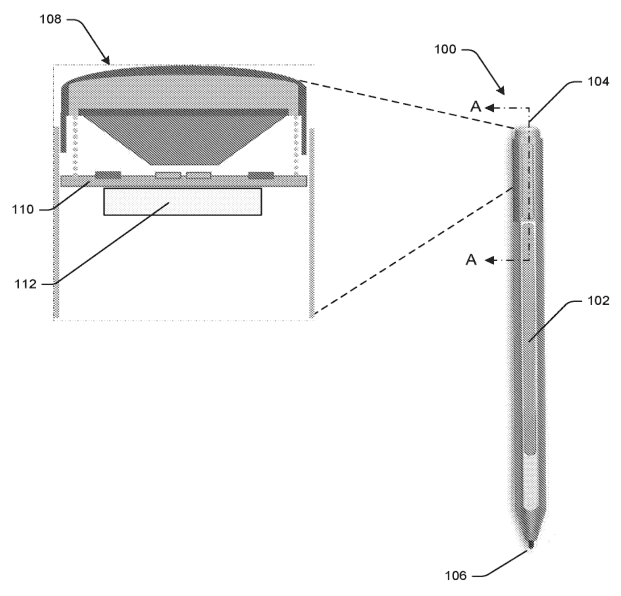
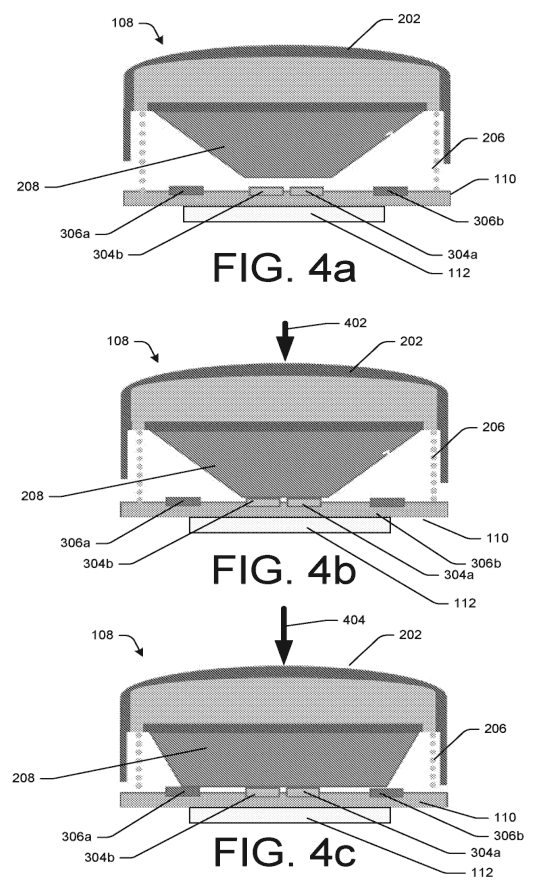
This patent covers a pen-shaped touch stylus that uses the removable tail-cap/eraser as a two-stage mechanical switch. A conductive, resilient insert in the cap deforms to bridge one set of PCB electrodes under a light press (to send an erase signal) and bridges a second set under a deeper press (to send a different wireless command). It is aimed at tablet and 2-in-1 users who want erase and shortcut/app-launch controls from the stylus tail.
(57) What the patent covered
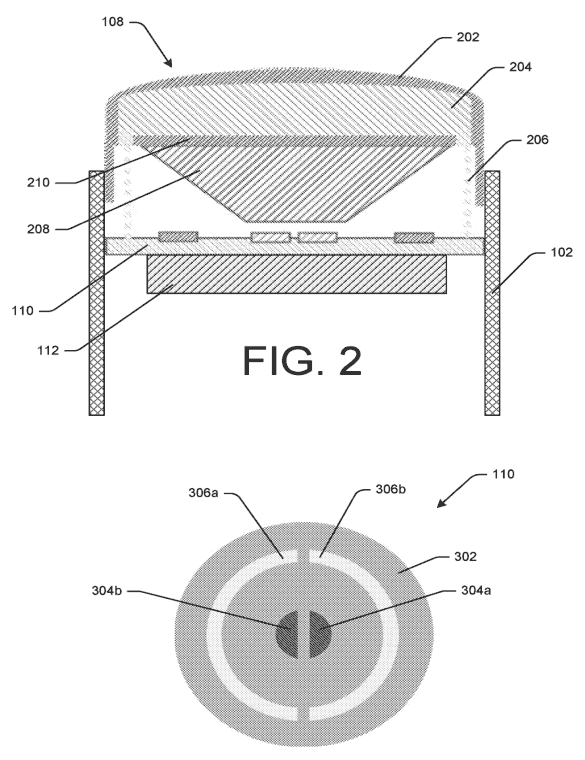
The independent claim requires a barrel with a PCB carrying two discontinuous electrodes (each a pair of traces separated by a gap), a slidable cap with an eraser electrode and a conductive resilient body that, as the cap is slid in two discrete amounts, first contacts the first electrode pair and then, with further travel, contacts the second electrode pair; and a microcontroller that detects continuity of the first pair to output a first signal and continuity of the second pair to output a second (wireless) signal.
The distinctive part: Using a single resilient conductive polymer element within the eraser cap to make two distinct electrical contacts at two different insertion depths, enabling two functions from one tail button.
Novelty 3/5. Two-stage push buttons and conductive rubber contacts were known in consumer electronics, but applying a compressible conductive body as the stylus tail eraser to provide distinct erase and wireless-command signals was a practical improvement on existing stylus buttons.
Making it
Injection-molded plastic or machined metal barrel, FR-4 PCB with plated copper traces, molded conductive elastomer insert for the cap, and hand or machine assembly to seat the PCB and cap together.
Materials: Polymeric barrel (likely ABS or aluminum) or metal body, Printed circuit board (FR-4) with copper traces, Conductive resilient polymer (e.g., carbon-filled silicone or conductive elastomer), Non-conductive insulator separating eraser electrode (soft foam or plastic)
Manufacturability 4/5. Requires several simple parts (barrel, PCB, molded cap with conductive insert, microcontroller) and alignment during assembly but no exotic tooling beyond standard molding, PCB fabrication and assembly.
Is anyone buying?
This design, or something very close to it, is on sale now. Product page explicitly lists 'Tail Eraser & Barrel Eraser Button' and 'Not compatible with certain Surface models' with USB-C charging and 4096 pressure support; US storefront available and cart-ready.
- Raphael 530T Dual Eraser Stylus for Surface · RENAISSER
This demand check was run with a web search in the week of Oct 5, 2026. Listings change often, so treat it as a starting point for your own research.
Who buys it: tablet and convertible laptop users, digital artists and professionals who use active pens
Before you make it
We didn't find any related continuation or divisional patents still in force, although that doesn't rule out design patents, trademarks or unrelated patents covering the same product.
Practical issues include reliable long-term conductivity and wear of the conductive elastomer, tactile feel tuning and firmware to disambiguate presses, and a crowded stylus accessory market; no legal advice about infringement is provided.
Owners occasionally revive lapsed patents (about 1.5% are), and this page is a research lead rather than legal advice, so get a freedom-to-operate opinion before you manufacture anything.