Knotless suture anchor with a filament-based locking element
A bone anchor designed to capture a suture passed through a side window in the anchor body using a distal locking element pulled proximally by a looped pull line. Surgeons place the elongated anchor in bone, pass the suture through the window into the anchor lumen, then tension the pull line so filaments in the locking element cinch the suture against an internal shoulder to secure tissue without tying knots. Intended for soft-tissue-to-bone repairs such as labrum or rotator cuff work.
(57) What the patent covered
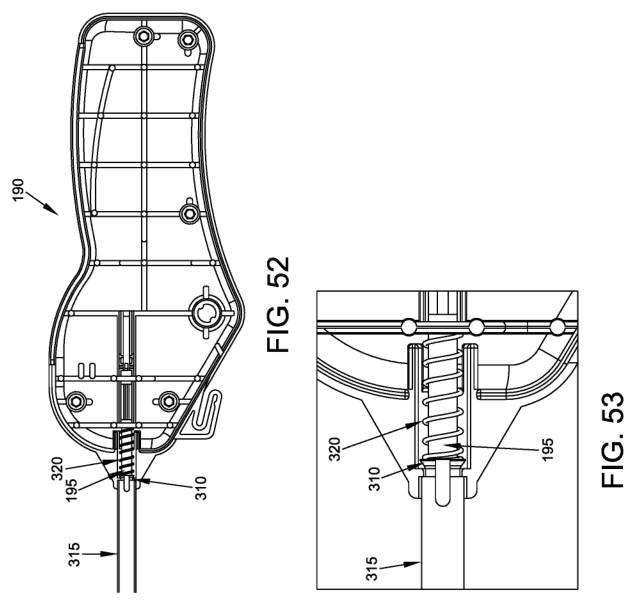
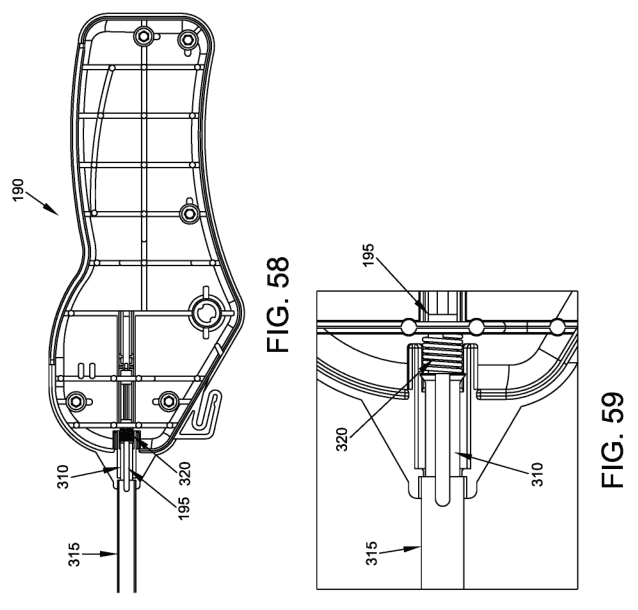
The independent claim covers an elongated tubular anchor with a lumen that has a wider distal section and narrower proximal section, a side window at the junction sized to accept a suture, an elongated pull line that ends in a loop, and a distal locking element with one or more filaments that pass through that loop; pulling the pull line proximally draws the filaments to capture the suture in the lumen and secure it to bone.
The distinctive part: A distal locking element made of one or more filaments that pass through a looped pull line and are drawn proximally to trap the suture through a side window inside a stepped lumen.
Novelty 3/5. Knotless suture anchors were already known; this patent's twist is the specific filament-through-loop locking assembly operating in a stepped lumen with a side window, a modest but clear mechanical variation on existing knotless anchors.
Making it
Injection-molded polymer body with post-machined or molded lumen/side window, stamped or laser-cut metal filaments or nitinol wires for the locking element, braided suture and pull line, assembled by hand or semi-automated insertion of locking element into the distal lumen and capture of the pull line loop.
Materials: Medical-grade polymer (e.g., PEEK or polyether block amide) for the anchor body, Stainless steel or nitinol filament(s) for the locking element, Braided suture material (UHMWPE/polyester), High-strength monofilament or braided pull line (polyester/PEEK-coated)
Manufacturability 4/5. Several simple molded parts plus small metal filaments and manual or semi-automated assembly to insert the locking element and thread the pull line loop; no complex electronics but tight tolerances on lumen and window sizing are needed.
Is anyone buying?
We haven't run a demand check on this one yet. Shoppers would likely search for knotless suture anchor, suture anchor with pull loop, side window bone anchor; the links on the right open those searches.
Who buys it: orthopedic surgeons and hospitals for soft-tissue-to-bone repair
Before you make it
This patent has 5 related US patents (continuation, divisional or parent) that may still be in force: US 10,092,285, US 9,149,268, US 9,451,943, US 9,179,905, US 9,101,355. Read their claims before going further.
Regulatory clearance (FDA 510(k)) and existing crowded market of knotless anchors are practical hurdles; patent has lapsed so no enforcement risk but check for other active patents covering similar locking mechanisms.
Owners occasionally revive lapsed patents (about 1.5% are), and this page is a research lead rather than legal advice, so get a freedom-to-operate opinion before you manufacture anything.