A Y‑shaped shoelace set that ties at three vertical points
This is a pair of Y‑shaped shoelace assemblies where each assembly splits into three separate lace strands that run through the shoe eyelets and are tied to the matching three strands from the opposite side, creating three tied points down the throat of the shoe. It’s aimed at shoe wearers who want more than one central tied point to adjust fit along the instep and forefoot. The laces are described as discrete strands with heads and connector junctions rather than a single continuous cord.
(57) What the patent covered
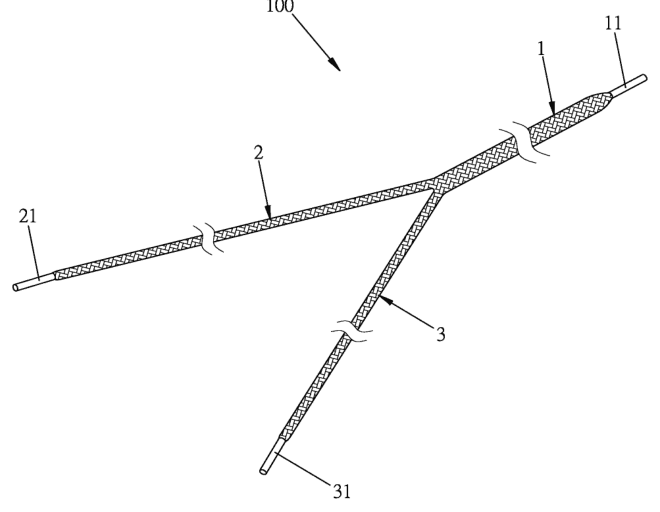
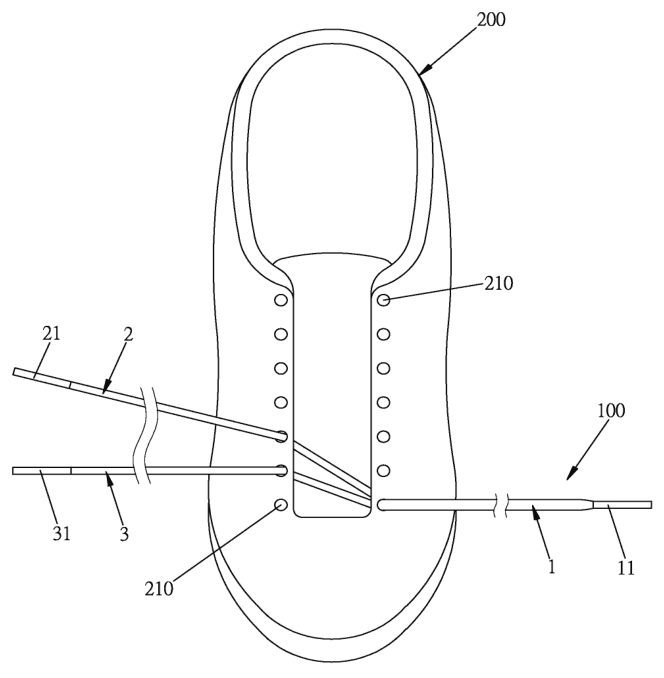
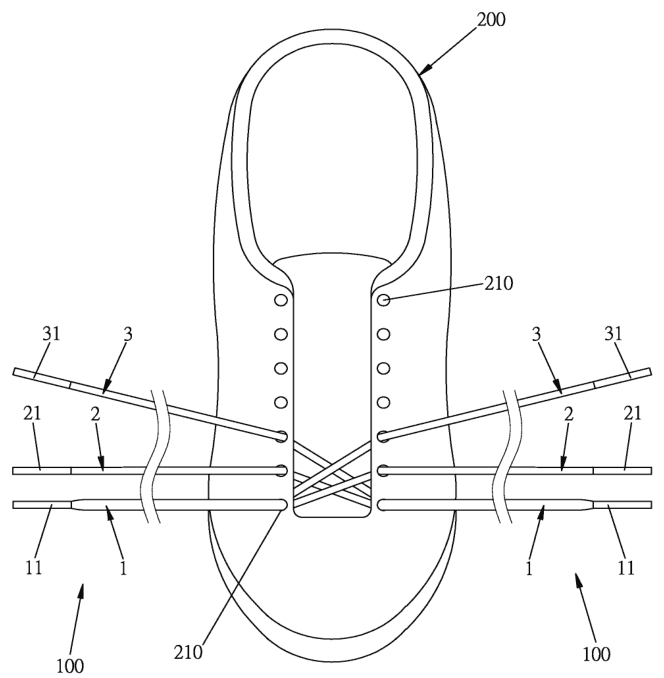
The main claim covers two matching three‑way shoelace assemblies; each assembly has a first lace with a head, a second lace with a head whose free end is joined to the free end of the first lace, and a third lace with a head whose free end is joined to the same junction so the three form a Y‑shaped unit; the two assemblies are laced through a shoe’s eyelets and the corresponding first, second and third laces of the two assemblies are tied together to form three bow‑tied points that secure the foot at three locations.
The distinctive part: Lacing is done with preformed three‑strand (Y) lace units that produce three separate tied points when two units are crossed and tied to each other.
Novelty 3/5. Splitting a lace into multiple branches and making fixed junctions is a straightforward improvement on standard single‑cord laces and on decorative multi‑cord lacing; the idea is a clever extension rather than a wholly new fastening method.
Making it
cut and braid or knot multiple cords, attach or overmold plastic heads/aglets, form a junction by stitching, bonding, or overmolding; final assembly by trimming and heat‑sealing ends
Materials: woven polyester or nylon cord, coated cotton cord, molded plastic aglets (heads), small thermoplastic junction or overmold
Manufacturability 4/5. Parts are simple cords and a small junction/heads; production needs braiding/cutting, insertion of aglets and a bonding or overmold step but no precision mechanisms.
Is anyone buying?
We haven't run a demand check on this one yet. Shoppers would likely search for three way shoelace, Y split shoelaces, multi point shoe laces; the links on the right open those searches.
Who buys it: people seeking adjustable fit along the instep; runners, hikers, or anyone with variable foot volume
Before you make it
We didn't find any related continuation or divisional patents still in force, although that doesn't rule out design patents, trademarks or unrelated patents covering the same product.
Practical risks are small but market may be limited by consumer preference for standard laces and by fit variability; patent lapsed so no enforcement, and the description is fairly broad but also somewhat vague about junction and spacing details.
Owners occasionally revive lapsed patents (about 1.5% are), and this page is a research lead rather than legal advice, so get a freedom-to-operate opinion before you manufacture anything.